
Arrrgghhh ……….. like a horror film when the character you thought would make it suddenly snuffs it early on, and then in quick succession another victim is claimed before you’ve had a chance to recover from the first; a double shock.
With much the same inevitability as a classic horror film’s plot, so calls for a new round of austerity cuts have already started to gather pace, even whilst we’re still in the midst of the current crisis. Addressing the CBI earlier this week, ex Chancellor George Osborne, the architect of the last era of austerity is already calling for another round of cuts once the immediate Coronavirus crisis is over[1]. Part zombie, part vampire, the deathly misguided ideology which sustains austerity keeps coming back from the undead, sucking life out of society, void of emotion for the inevitable human cost. The cold eyes of those who call for austerity I’m sure look upon it as little more than an accounting exercise, safely insulated as they are from its negative and often deadly effects.
Curing debt with debt?
Only a matter of weeks ago, Chancellor Rishi Sunak was being lauded as some kind of unlikely socialist for the necessary state intervention to prop up the economy in our current time of need. The ex-Goldman Sachs/hedge fund manager was praised for his pragmatic approach to dealing with the crisis, with the oxymoron obviously lost on those who claimed his ‘business approach’ in dealing with political problems was refreshingly ‘non-ideological’. Whilst not explicitly warning of more austerity, he was keen to signal at this early stage that ‘taxpayers’ money will need to be paid back’. Of course time will really tell the extent to which this ex-Goldman Sachs/hedge fund manager Chancellor is ‘non-ideological’, but I suspect that not holding your breath might be good advice. As George Osborne’s early clarion call for more austerity demonstrates, I think it would be extremely naïve to imagine all the usual suspects will not be clamouring for another era of austerity.
They will justify it with faux concern for the next ‘generation’, who they will say should not be burdened with the public debts of this generation. It’s obviously so much better to burden them with their own private debt, and for them to inherit a fractured society ripped apart by cuts to public services and employment regulation, than to live in some kind of unrealistically utopian society in which everyone pays their fair share of tax through which to pay off the public debt.
They will use fallacious analogies such as those comparing government debt to household debt. Deceitfully appealing to what appears as a simple truth; that you can’t cure debt with more debt. Despite in the context of public debt this being simply wrong. In order to pay off debt you need to generate income to do so, and the best vehicle for doing this in a downturn is the state. Whilst one household alone can indeed reduce its debts if it cuts back on spending, government austerity measures are not equivalent to one single household. Government spending accounts for around a quarter of all spending in the economy, which is the equivalent of around six million households all trying to cut their budgets at the same time[2]. It simply doesn’t work. If everyone is saving, no one is spending, and therefore economic growth is sluggish, which in turn reduces the tax revenues necessary to pay off the debt. Ten years of failed austerity has proven this, in cash terms the public debt is now almost double what it was when austerity started. It didn’t work over the last ten years and won’t work over the next ten. But let’s take a brief look back to see how we got here ….
Austerity: the impact
On the 14th April the Office for Budget Responsibility estimated the UK government may well need to borrow something in the region of £273bn this financial year to cover the costs of responding to Coronavirus. This would result in a deficit of around 14% of UK GDP[3]. At its peak, the deficit in the aftermath of the 2008 financial crisis reached 10%[4]. The UK Labour government at that time, along with many other national governments initially adopted a Keynesian policy response (essentially the opposite to austerity), with a £21bn fiscal stimulus, however on gaining power in the 2010 election, the Conservatives with the help of the Liberal Democrats reversed this policy agenda and adopted a crippling austerity regime. This saw the largest reduction in state spending since the Second World War and led to an increase of at least 800,000 children and 1.5 million working age adults falling into poverty. Far from us all being in it together as Conservative leader David Cameron couldn’t stop telling us at the time, it was the poorest 2/10s of the population who were the hardest hit[5]. In addition, austerity led to a decade of economic stagnation, rising living costs while incomes fell, and an increased unemployment rate for five years. Budgets across government were slashed, with local councils fairing worse, seeing average cuts of over 50%, with work and pensions next at 35%[6]. These are the budgets the most vulnerable in our society rely on most, and therefore it should sadly surprise us less that some have estimated the cuts accounted for around 130,000 preventable deaths as a result of the political choice to impose austerity[7].
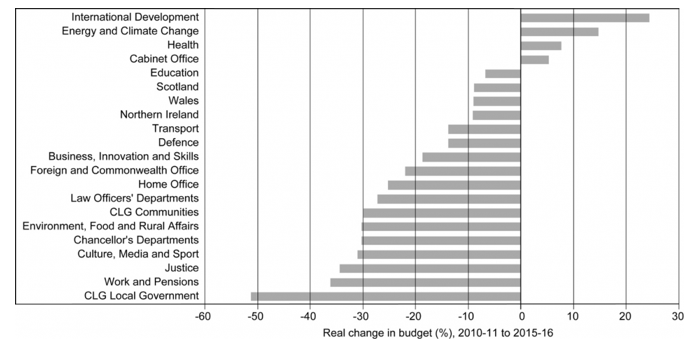
[8]Local government and Work and Pensions were the worst affected.
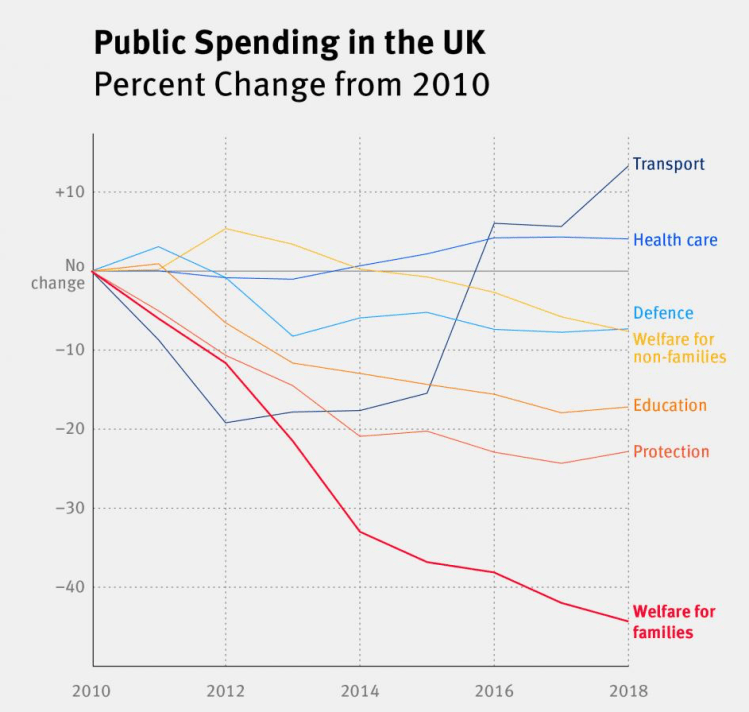
[9]Budget cuts targeted those on which the most vulnerable were reliant.
Debt or deficit?
Considering such a high price was paid over such a long period of time, you’d have expected this bitterest of pills we were forced to swallow would have ultimately made us better. If so you’d be wrong, although you’d be forgiven for getting a little confused, as the architects of austerity (I suspect knowingly) often confused its two targets; namely the national deficit, and the national debt[10].
The former is the excess amount the government has had to spend above that which it brings in in revenue in any year. The government must raise this excess through borrowing. The latter is the total sum of government debt which has accumulated over time. Up until the financial crisis, this long run public debt had averaged around 30% of annual GDP during Labour’s tenure. As you can see from the graph below, contrary to Tory and Liberal Democrat claims that Labour’s time in office was characterised by profligate debt fuelled spending, they actually reduced the public debt from that inherited from the Tories on taking power in 1997.
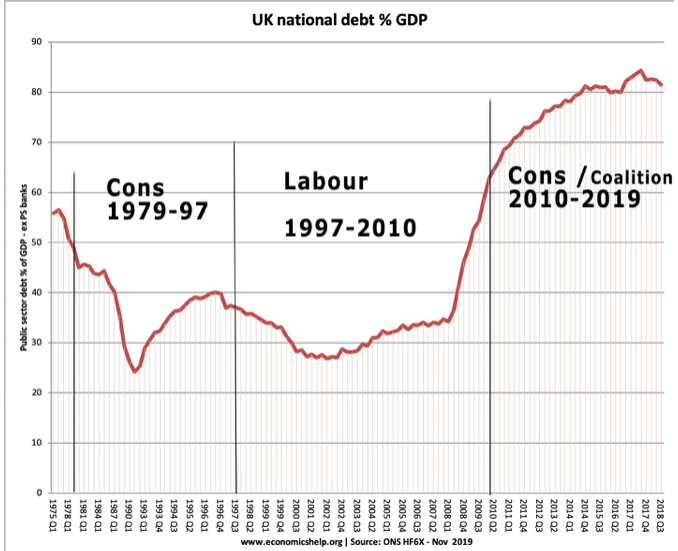
[11]Labour reduced the public debt they inherited from the Tories.
As the graph indicates, it was the cost of bailing out the banks in 2008 which initially forced the Labour government to increase their borrowing to shore up the banking sector by £136.6bn[12]. But besides this hit to the public purse, two secondary effects of the financial crisis further increased public debt: one is the increased demand in a downturn on automatic stabilisers such as welfare payments, whilst the other is that the downturn reduces the tax revenue the government is able to collect. Of course, one compounds the other, at just the time that government expenditure increases, so its income is cut through falling tax revenue. It is to counter these effects that Keynesian policy dictates that trying to cut a budget deficit during a downturn is precisely the wrong time. As demand in the economy is subdued, investors lack the confidence to invest, so undermining secure employment, and thus a negative feedback loop is set in motion. To counter this, governments need to step in and provide funding to the economy, financed through borrowing in order to stimulate demand and thus renew investor confidence. This in turn feeds through over time to once again increase government tax revenue by which to pay off the debts incurred by the stimulus. It was this policy framework which was initially adopted by most Western governments in 2008[13]. Through a combination of cuts to VAT and earlier capital investment spending, the Labour government effectively injected £21 billion (in addition to the bank bailouts) into the economy to stave off the worst excesses of the recession, resulting in the UK economy growing at a rate of 3.3% between autumn 2009 – autumn 2010. Once the Tory coalition took power the following year and imposed austerity, growth dropped to just 0.3% during that period[14]. It has remained sluggish ever since, growing on average only 1.6% over the last nine years, with the recovery officially the slowest on record, surpassing even the slump of the 1920s[15].
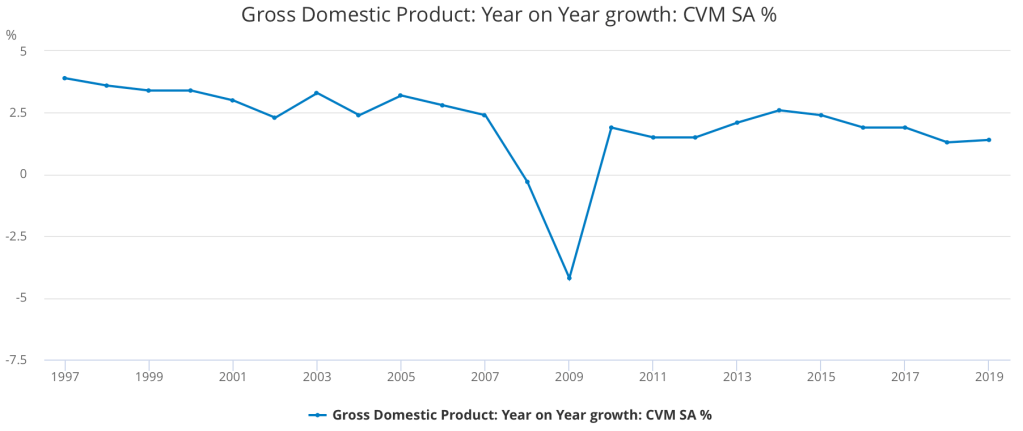
[16]Economic growth averaged only 1.6% per year over the last nine years.
Such sluggish growth translates into lower tax revenue with which to pay off the debt, and therefore prolongs the period in deficit. This has been compounded all the more as the much vaunted ‘record’ fall in unemployment overseen by the Tories has been characterised by low waged, ‘flexible’ under employment, which is designed by employers to pay as little tax as possible. Whilst at the same time they have cut both the top rate of income tax from 50 – 45%, and corporation tax from 28 – 19%[17]. This was all the more reckless when you consider prior to the 2008 crisis, UK tax take had become too reliant on the finance sector, such that when it contracted, so did the taxes it paid to the Treasury. Reducing other sources of tax at such a critical time was driven by the misguided ideology that lower tax rates yield more in revenue. As you can see from the graphs below, it didn’t work.
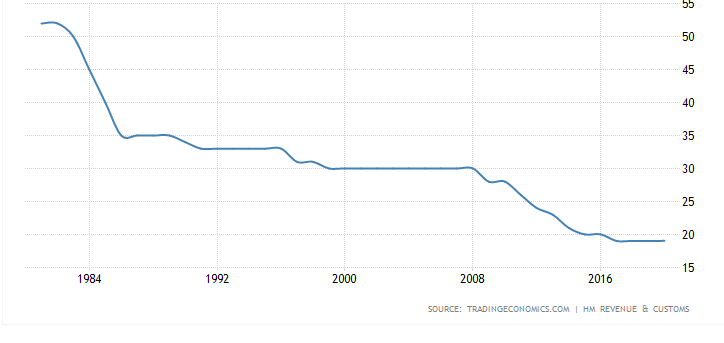
[18]Corporation tax rates have been cut to their lowest rates on record.
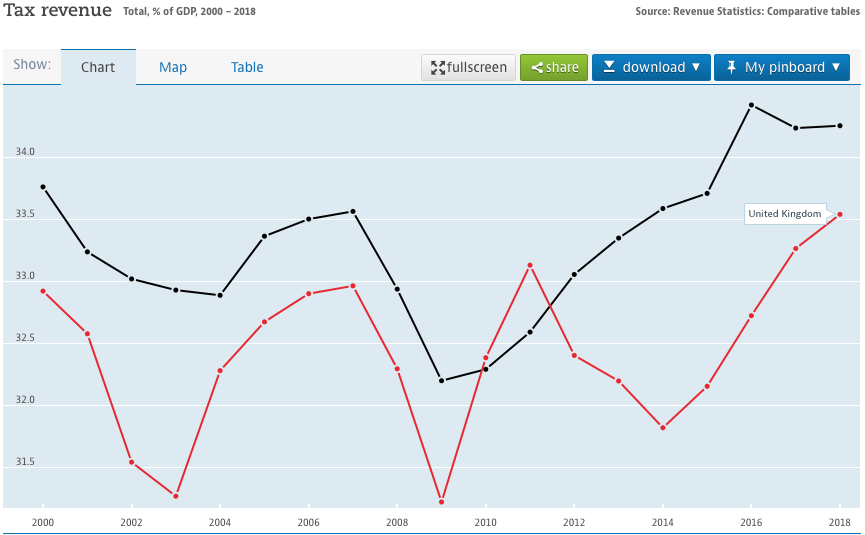
[19]You can see the fall in tax revenue as austerity set in. The black line is the OECD average.
It is these dynamics which resulted in the deficit only being paid down at a rate of a mere 1% a year,[20] and therefore the size of government debt inflate from an average of 37% of GDP during Labour’s tenure up until the financial crisis – which then resulted in it increasing to 65% by the time the Tories came to power in 2010 – to still standing at 84.6% of GDP in March 2019, and predicted to rise above 100% of GDP consequent of Coronavirus.
Reframing the narrative
Despite both the Tories and Liberal Democrats backing the 2008 borrowing which was necessary to bail out the banks, a year later they had reframed the source of this debt as evidence of a profligate Labour government recklessly over spending during their time in office[21]. Reducing the public debt became the centrepiece of their 2010 election campaign, and the justification for their brutal policy of austerity. In his 2009 ‘Age of Austerity’ speech at the Tory party spring conference, then leader David Cameron claimed:
“Labour are spent, the money has run out. Now some people say: let’s get through the recession, let’s get through the election we can keep on spending more, keep on borrowing more, and deal with the debt crisis later. Wrong – seriously wrong. The alternative to dealing with the debt crisis now is mounting debt, higher interest rates and a weaker economy. Unless we deal with this debt crisis, we risk becoming once again the sick man of Europe. Our recovery will be held back, and our children will be weighed down, by a millstone of debt.”[22]
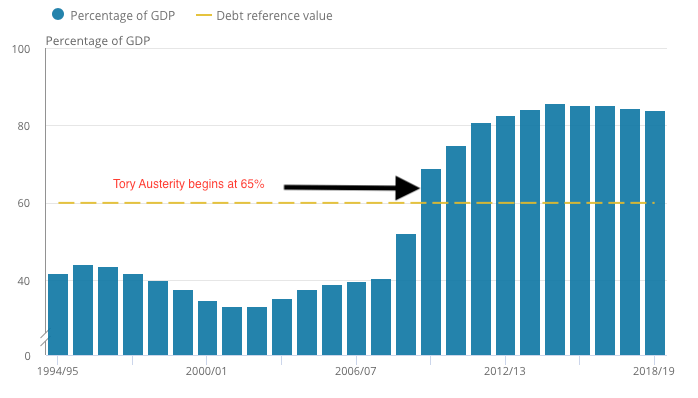
[23] You can see how much public debt has risen because of austerity.
Not only did a decade of crippling Tory austerity plight the lives of millions of people, we can see from the graph above that even on its own terms it utterly failed to reduce the debt, instead almost doubling it in cash terms from £1 trillion – £1.8 trillion [24]. No wonder they were so quiet about the ‘debt’ during the 2019 election campaign.
Whilst Labour were compelled to increase the debt in order to bail out the banking sector, the increase under the Tories tenure is down to the complete failure of austerity policies. Whilst it’s true they eventually reduced the deficit, this was painfully slow and only achieved by brutally cutting the vital and hard-won public services of the most vulnerable in our society, rather than overseeing a growing economy able to deliver healthy tax revenues through which to pay off the deficit and rebalance the nation’s finances in a fair and humane manner. In fact, the New Economics Foundation calculated that austerity cost the UK economy around £100bn in lost economic activity, that’s a loss to every UK household of £300 a month for almost a decade[25].
Austerity: a political choice
The reframing of the debt and deficit as a result of profligate spending by Labour implied that the nation as a whole had enjoyed an unsustainable period of excessive government spending, rather than the actual truth that the debt, deficit, and recession were a consequence of the reckless excesses of the finance sector. Not only did the actions of this extremely wealthy minority cause the crisis in the first place, they were then able to protect their assets by having the state pay their debts, and then transfer the burden of responsibility for that debt on to those who had never even benefitted from the fruits of the excesses in the first place.
In facilitating this, the Tories and Liberal Democrats made a political choice about the distribution of resources, rather than what they attempted dress up as choiceless economic necessity. They chose to target the lower to middle socioeconomic sections of society who are reliant on the direct and indirect state transfers to pay off those debts, whilst those who were actually culpable were given tax cuts, such is the perversity of austerity politics.
It is worth remembering that these various state transfers that were cut did not just appear one day in the past because of the generosity of the wealthy. They are the product of long fought political battles that our forefathers struggled to gain. In so doing they stabilised capitalism and facilitated the expansion of a middle class, – a class political scientists will tell you is essential to a functioning democracy. It’s no exaggeration to say that the consequences of austerity can become very dangerous indeed. The recent rise of populism and nationalism should not come as a surprise; they are all too often the handmaidens of austerity. They are now, just as they were before WWII, but we’ll have to explore that historical aspect of austerity another time[26].
Another political element to austerity which is concealed by the cloak of ‘economic necessity’ is the legitimisation of the long run Conservative privatisation agenda. During the last ten years of austerity, over 20 state owned (or part owned) organisations were privatised [27]. Many of them disastrously so, such as the privatisations stemming from cuts to the Ministry of Justice which saw both the UK Forensics Science Service and the Probations Service sold off. Such was the unmitigated disaster of the latter it was recently renationalised, but only after a series of catastrophic blunders of the early release of very dangerous unreformed prisoners who went on to commit awful crimes[28]. Whilst privatisation of the FSS led to the recall of 10,000 criminal case samples, the biggest in British legal history after fears the data had been manipulated [29]. Add to those two the renationalisation (again) of the East coast rail line, and the collapse of Carillion after taking over many public service roles. The story is a familiar one; private failure, public rescue. But only that is, after the private sector has looted the company accounts and passed the hollowed-out debt ridden entities back to the state and onto the books of public debt.
The ideological privatisation of these institutions was obscured by the austerity narrative, and the many who have suffered as a result of the failure of this process should be added to those already listed above.
2020 is the new 2008
Although there is a case to be made that a pandemic arriving on our shores in the aftermath of ten years of brutal cuts to public services, and highest public debt since the Sixties, have almost certainly resulted in more economic pain than may have been otherwise necessary, and has certainly contributed to the number of lives lost, it’s true to say that unlike the man-made financial crisis, coronavirus is more an act of nature. This I’m sure will be weaponised to justify cuts ‘across’ society. But as we know from austerity, cuts to the state budget fall disproportionately on those in most need, they do not fall equally across society.
Yet whilst the cause of this crisis may be more ‘natural’, many of the same fundamental dynamics at the root of the last bailout are apparent in this one. Not least a super wealthy elite who are happy to deride the state and avoid paying their fair share of taxes in the good times, yet as soon as a crisis arises, they seek the protection of the state to protect their almost obscene levels of wealth. Take for example two high profile claimants of public money. Sir Philip Green and Sir Richard Branson. Both have conspicuously avoided paying their fair share of taxes by storing their wealth in offshore tax havens, whilst their unscrupulous past business behaviour has already cost the UK taxpayer dearly. The former is not only infamous for asset stripping the BHS group and raiding its pension, only to then transfer its liabilities onto the UK tax payer, he has also paid his staff such low wages that the state has effectively subsidised his payroll through hundreds of millions of pounds in tax credits[30]. Whilst the latter controversially received a pay out from the NHS after his Virgin group complained about a tendering process.
Of course, it’s easy to pick out two pantomime villains to express my point, but the broader fact remains; the corporate world, encompassing both the managerial elite and the business models they adopt, have embraced tax avoidance measures as a fundamental characteristic of both their personal and professional modus operandi. As we have noted above, it is precisely this type of behaviour which reduces tax revenues, and therefore hinders the reduction of the public debt. Yet despite this, the UK is the biggest enabler of corporate tax dodging in the world[31].
Definitely business must be supported during times of crisis, but surely in a just society this must be balanced with fairness. France and Denmark for example are sending a very clear message to their corporate sectors via the medium of state support, by only bailing out those businesses who are not paying out dividends or engaging in share buybacks during the crisis, or which are registered in tax havens[32]. It should not be business as usual while Rome burns.
Unfortunately, and somewhat unsurprisingly, the ex-Goldman Sachs/hedge fund manager Chancellor Sunak, has sought no such conditionality for corporates to access UK state support, with Easy Jet paying out a £174mn dividend to shareholders just days before receiving a £600mn state backed loan[33]. But rather than address what is evidently a fundamentally flawed business model, the ex-Goldman Sachs/hedge fund manager Chancellor, and the Bank of England, have sought to shield themselves from public scrutiny by imposing confidentiality agreements surrounding their actions[34]. All we know so far is the ‘Covid Corporate Financing Facility’ has already paid out £7.4bn, yet it is only accessible to huge investment grade corporations. Whilst it’s true these account for 40% of UK employment, small and medium size enterprises account for over 60%, yet by last week they’d only received around one seventh of the support these tax avoiding corporate giants had received[35]. These are vast amounts of public money which are being spent with no transparency, and which no doubt later will be bundled together with the rest of the ‘public’ debt and presented to us as the ‘cost’ of paying for the Coronavirus. A cost which as we have seen before is burdened on the shoulders of those least able to bear it.
Who exactly is the utopian?
Proponents of austerity are ideologically wedded to a neoliberal worldview of markets as inherently naturally equilibrating. In their simplistic world, savings are never hoarded, but rather always flow into investment, which in turn stimulates employment and thus wages, driving up consumption which leads to profits, and ultimately back round to reinvestment again. All functioning like a finely crafted Swiss watch. The problem is that at the best of times it doesn’t much work like that, but completely malfunctions during a downturn, when investors are reluctant to invest as they don’t feel there’s sufficient demand in the economy. In this event, the more rational action is often to hoard savings. It’s known as the paradox of thrift. As we noted at the beginning of the article, if everyone does this at the same time, no one is spending and thus consumption falls. This can then lead to more unemployment and even less consumption and so on in a downward spiral. Such a subpar level of economic activity can continue for years, and it is in seeking to avoid this that Keynesian economics starts with stimulating demand via the capacities of the state to ‘jump start’ the economy. Neoliberals however consider such ‘interference’ in the economy runs the danger of crowding out private investors who’ll be reluctant to compete with the state. They think it’s better in a downturn to just wait and let markets (such as wages) find a new more competitive (lower) level. In effect, don’t try and buck the market and accept that wage rates are always at the mercy of markets finding their right equilibrium. Essentially, if only everyone accepted their lot and conformed to the dictates of the market, then the messy business of politics wouldn’t interfere in the smooth functioning of the economy. The problem is that in democracies, people generally begin to push back against such insecurity in their lives. It is to this end that neoliberals have sought to insulate the economy from ‘democratic’ politics; the austerity narrative of a choiceless economic ‘necessity’ being a perfect cloak.
That however is not to say that being shielded from ‘democratic’ political pressure equates to an absence of political motivation behind austerity. On the contrary, as the relative impact of austerity on different socioeconomic groups highlighted earlier in the article exposes, the economic choices themselves are actually the very definition of political. Different economic theories empower and disempower different socioeconomic constituencies. Austerity and the neoliberal theory on which it’s premised is what’s known as ‘supply’ side, meaning that the state works more in the interests of the wealthy, the suppliers of goods and services, for example by cutting taxes and reducing employment regulation. This is in contrast to Keynesianism, which is known as ‘demand’ side as it focuses on stimulating demand in the economy by increasing the consumption of the less wealthy, for example by providing welfare payments collected through taxation.
When you start to unpick the economic logic and unrealistic assumptions of an economy void of political reaction to negative market effects which underpins the reasoning behind the austerity agenda, you can begin to see it as ridiculously utopian. Yet despite this, austerity proponents dress up their utopian aims with seemingly simple truths such as ‘you can’t reduce debt with more debt’, which can have an instinctive appeal, especially on the micro individual level that we generally view the world. Yet on another level, we all know through our lived experience – right now with Coronavirus being a good example – the world does not run smoothly like the well-oiled machine of neoliberal dreams. Crises abound, economics is politics is economics is politics. We are no more able to reach the utopian Shangri-La of neoliberalism, than we are those of any other ideology neoliberals tell us are unrealistically utopian, and thus in the meantime we are compelled to deal with the reality of crises as they present themselves. We cannot, as the proponents of austerity seek to force us, just keep putting our lives on hold for decades whilst we wait for markets to ‘naturally’ find their equilibrium, they don’t, and then another crises comes along anyway. As Keynes reminded us, ‘in the long run we are all dead’. Therefore we need to be able to live and prosper in the context of a large public debt, whilst gradually reducing it through an equitable tax system and thriving economy.
Shock horror, you can actually live with debt
The rather inconvenient truth that austerity proponents ignore, is that following the Second World War the UK had a debt to GDP ratio of close to 250%. Not only did we slowly reduce this down to around 30% of GDP by the end of the Sixties, we did so whilst setting up the NHS and the welfare state, all of which contributed to the economic activity through which the debt was paid down. Such was the economic and political stability of the period, it became known as the Golden Age of Capitalism.
One of the most fundamental differences between then and now is that the state played a much more active role in the economy, efficiently collecting taxes, and ameliorating the worst excesses of the market. Forty years of neoliberalism have left us with a very different relationship with the state, but history has shown us that what appears impossible one day, can often be inevitable the next. We don’t have to be encased in another neoliberal coffin, enduring endless rounds of austerity grinding society ever further down. We have choices.
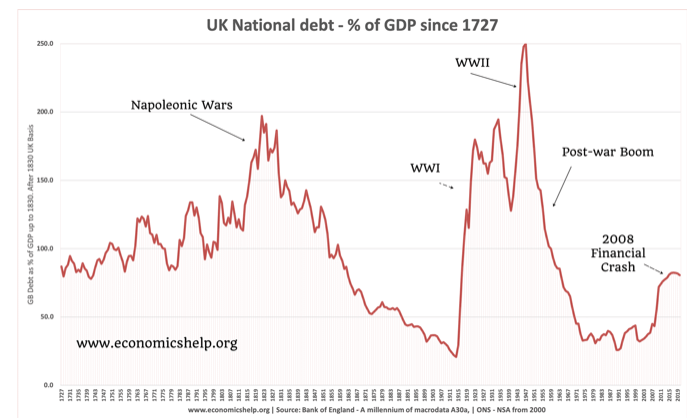
[36] Capitalism’s most productive and socially beneficial period happened in the context of a large public debt.
As many Keynesian economists have proposed, there has perhaps never been such a critical time in which we need to reorient our perception of the economy and the mainstream ideas through which we govern it.
The climate crisis has been compared to Coronavirus in slow motion. Both demand we reassess our perception of value and efficiency. Both cannot be addressed through the institutional framework of neoliberal capitalism.
In similar fashion to the stimulus that post-war reconstruction gave to the UK economy in the years following the war, so could state directed investments in a Green New Deal[37]. It could both help reduce our carbon emissions, whilst also providing well paid employment through which to gain the tax revenue to pay off the debt. Principal to this though would be replacing the UK’s current sieve-like tax enforcement, so that a fair proportion of the revenue generated can be ploughed back in to paying off the debt. The current system is nothing short of the crony capitalism that we so often accuse those in less developed countries of engaging in. As Ann Peitifor, one of the architects of the Green New Deal has highlighted, off-shore tax havens are stuffed full of somewhere between $8-35 trillion dollars of unproductive capital, currently out of the reach of tax authorities[38]. As noted earlier, that the UK is the biggest enabler of corporate tax dodging in the world, makes our government supremely empowered to address this. The fact it doesn’t reveals both the lie that austerity is all about balancing the books, and exposes its raw political motivations in serving the interests of the wealthy. After all, why is it that arguments around efficiency are always wheeled out when it comes to cutting the public services, but when it comes to collecting the tax revenues through which they and the public debt should be serviced, the Tories have no such rigour in ironing out inefficiencies?
Zombie amnesia?
So to conclude, the Tories came to power in 2010 saying that a period of austerity was needed to pay down the national debt. It didn’t work and the debt is now almost twice what it was. Yet ten years later with an even greater debt than when it started, the architects of this failed project have the audacity to still claim that we need even further austerity cuts than the ones they instigated and from which our public services have yet to recover, in order to…….reduce the debt. It’s part zombie mentality which sees them chained to an economic ideology which fails to correspond coherently to reality, part contempt for the public intellect, knowing that with the help of their tax avoiding owners, much of our mainstream and social media will help reframe economic reality to suit their agenda. But as this article highlights, you really don’t need to look too hard to see the economic inefficiency of austerity policies. And that’s aside from their negative social and political impact. The Tories however, with their callous disregard for the vulnerable, seem content to accept this subpar economic world. Happy to use the deficit narrative as a cloak from which to obscure the undemocratic underpinning of the neoliberal ideology they embrace, to push private sector interests further into the domain of public services.
Of course a new round of austerity almost certainly won’t be called a new round of austerity once the crisis is over. I imagine the likes of Dominic Cummings are already dreaming up snappy three word slogans they can use to distract the public from the actual reality that it’ll be their public services disappearing. ‘Cuts For Control’ or ‘Get the Deficit Done’ maybe?
But whatever they call it, we can be certain that undertaking another round of budget cuts when so much of the damage the last ten years of austerity has wrought on society still remains would truly be a horror film for many in our society, and without doubt open even greater sores than the divisions brought about by Brexit. I do hope politicians and public alike can see the dangers of this zombie ideology lurking in the shadows, and drive a steak through its cold undead heart once and for all. The future is ours to make, let’s reinvent it anew.
[1] https://www.bloombergquint.com/global-economics/architect-of-u-k-austerity-says-retrenchment-needed-post-crisis
[2] https://www.tuc.org.uk/sites/default/files/ThePriceofAusterity.pdf
[3] https://www.bbc.co.uk/news/business-52279871
[4] https://fullfact.org/election-2019/ask-fullfact-debt-deficit/
[5] https://www.bbc.co.uk/news/10393585
https://www.ifs.org.uk/publications/5711
[6] https://www-cdn.oxfam.org/s3fs-public/file_attachments/cs-true-cost-austerity-inequality-uk-120913-en_0.pdf
[7] https://www.theguardian.com/politics/2019/jun/01/perfect-storm-austerity-behind-130000-deaths-uk-ippr-report
[8] https://blogs.lse.ac.uk/politicsandpolicy/the-uneven-geography-of-austerity/
[9] https://www.hrw.org/report/2019/05/20/nothing-left-cupboards/austerity-welfare-cuts-and-right-food-uk
[10] https://www.channel4.com/news/factcheck/cameron-busted-on-debt-claims
[11] https://www.economicshelp.org/blog/7568/debt/government-debt-under-labour-1997-2010/
[12] https://cdn.obr.uk/March-2019_EFO_Web-Accessible.pdf#page=143
[13] https://www.ilo.org/wcmsp5/groups/public/—dgreports/—inst/documents/publication/wcms_194175.pdf
[14] https://www.theguardian.com/commentisfree/2012/feb/06/gordon-brown-save-world-uk
[15] https://www.independent.co.uk/news/business/analysis-and-features/uk-economy-latest-updates-feeble-recovery-record-spring-statement-ifs-recession-philip-hammond-a8255756.html
[16]https://www.ons.gov.uk/economy/governmentpublicsectorandtaxes/publicspending/bulletins/ukgovernmentdebtanddeficitforeurostatmaast/december2019
[17] https://www.newstatesman.com/politics/uk/2017/11/how-tax-cuts-rich-have-cost-country-dear
https://www.ft.com/content/30238556-2322-11e9-8ce6-5db4543da632
https://www.ifs.org.uk/publications/9207
[18] https://tradingeconomics.com/united-kingdom/corporate-tax-rate
[19] https://data.oecd.org/tax/tax-revenue.htm
[20] https://www.bbc.co.uk/news/business-39897498
[21] http://news.bbc.co.uk/1/hi/uk_politics/7658518.stm, https://www.telegraph.co.uk/finance/financialcrisis/3108477/Financial-crisis-David-Cameron-tells-Tory-conference-he-will-work-with-Gordon-Brown.html
[22] https://conservative-speeches.sayit.mysociety.org/speech/601367
[23]https://www.ons.gov.uk/economy/governmentpublicsectorandtaxes/publicspending/bulletins/ukgovernmentdebtanddeficitforeurostatmaast/december2019
[24] https://fullfact.org/economy/public-debt/
[26] Blyth. M, (2013), Austerity: The History of a Dangerous Idea. OUP Oxford
[27] https://en.wikipedia.org/wiki/List_of_privatizations_by_country#2010s_2
[28] https://www.theguardian.com/politics/2019/jun/30/chris-grayling-probation-privatisation-disaster
[29] https://www.theguardian.com/public-leaders-network/2017/nov/27/dubious-forensic-evidence-privatisation-public-services
[30] https://www.theguardian.com/commentisfree/2016/jun/15/philip-green-bhs-tycoon-tax-parliamentary-inquiry
[31] https://www.independent.co.uk/news/business/news/uk-corporate-tax-avoidance-havens-justice-network-dodging-a8933661.html
[32] https://www.bloomberg.com/news/articles/2020-04-18/denmark-extends-business-aid-to-increase-spending-by-15-billion
https://www.ft.com/content/c6bf2a72-e2c0-43cc-94af-35e998bf81fa
[33] https://www.thetimes.co.uk/article/easyjet-seeks-state-loans-but-pays-stelios-60m-d26jghjtx
[34] https://www.thelondoneconomic.com/business-economics/call-for-veil-of-secrecy-to-be-lifted-as-5-5bn-public-money-spent-bailing-out-big-business/10/04/
[35]https://positivemoney.org/2020/04/bank-of-england-provides-7-5-billion-in-big-business-bailouts-all-hidden-from-public-view/
https://www.theguardian.com/business/2020/apr/15/covid-19-bailout-loans-issued-uk-firms-banks
[36] https://www.economicshelp.org/blog/163755/economics/historical-uk-national-debt/
[37] Pettifor. A, (2019) The Case for the Green New Deal
[38] https://www.taxjustice.net/2020/03/27/could-the-wealth-in-tax-havens-help-us-pay-for-the-coronavirus-response/
 From the Outside Looking In