Featured

From Thatcherism to Trump: The failure of neoliberal philosophy to extinguish the political.

“This isn’t their Republican party anymore. This is Donald Trump’s Republican party!”  

The surprisingly rare veracity inherent in this statement pronounced by Donald Trump Junior at the political rally prior to the storming of the Capitol, signifies quite spectacularly how far from the intended apolitical outcome the consequences of the neoliberal project have led.  

In the same way the repressive communist regimes of the Soviet Empire were monstrous distortions of the societies envisaged by socialist intellectuals, today’s crony capitalist societies, sliding towards authoritarian fascism under the leadership of populist demagogues are far from the intended outcomes the intellectual progenitors of neoliberal philosophy dreamed of. Their aim had been to achieve an almost apolitical society in which one’s liberty was expressed in the marketplace, not the ballot box.  Instead, inexorable inequality, coupled with an incessantly negative narrative that the state and political establishment are enemies of the people, has resulted in a hyper politicised citizenry on both sides of the division their project has engendered.  

De-democratisation

Whilst the conspicuous economic policies of neoliberalism have indeed been successful in expanding the realm of the market, for example privatising public services, removing capital controls, deregulating the finance sector etc, it is a lesser-known objective of neoliberalism that the result of these and other economic reforms were intended to play an intrinsic role in de-democratising and de-politicising society. 

For Neoliberals, democratic institutions represent an artificial and destabilising influence on the ‘natural’ free functioning of the market. They envisage the market as an almost divine super-computer, which via the price mechanism, the finely balanced supply and distribution of products and services is mediated. Democracy, and the economic demands made by what they ultimately consider an ignorant mass, are viewed as destabilising the ‘natural’ functionality of the market. Whilst on the political level, democracies they would argue, expose the masses to the demagoguery of corrupt self-interested politicians, who, not only undermine the market, but individual liberty itself. As Neoliberals deem all human action to ultimately be driven by self-interest, they are highly sceptical of the concept of politicians and civil servants working for the ‘public good’. Further though, even if democracies can avoid empowering demagogues, Neoliberals would contend there is a fundamental conflict between the market and democracy, as both have opposing principles of justice. The market is premised on market justice, which accepts the need for inequality, prizes individualism, self-interest and the protection of ‘negative’ freedoms; that is the freedom from, for example, from the state and its powers of taxation. Whereas democracy is premised more upon the concept of social justice. As democracies operating in market-economy societies will be presented with inequality, and democracies are by definition a collective endeavour, democracies invariably seek to redistribute resources in the pursuit of the collective good and enact policies in order to achieve ‘positive’ freedoms; that is the freedom to, for example, to go to university. This requires subsidising the poorer members of the community via taxation. This tension between positive and negative freedoms is generally a zero-sum game, and therefore Neoliberals ultimately deem the expansion of positive freedoms – despite being legitimised by democratic action – as undermining negative freedoms, and as such undermining what they perceive to be liberty in its purest form. 

To this end, Neoliberals have not only sought to insulate the economy from politics – a prime example being the independence of the central bank – but attempted to incise as much as possible the political and social from society itself. The clearest instance of this has been the neoliberal attack on unions, which are both highly political and social organisations, and having developed in parallel with democratic emancipation through the late nineteenth and  the twentieth century, had historically formed one of the largest sections of civil society. Without the collective bargaining power afforded by unionising, individual workers are now rendered atomised and denuded of political power. This precarious status has inverted what was once a sense of solidarity with fellow workers, into constant competition between them. From a market perspective though, individualised workers are deemed far more efficient, as the fear of losing their (now) precarious job(s) disciplines them, making them much more flexible and accommodating to the vicissitudes of the market. 

One dollar – one vote

However, although Neoliberals are distrustful of democracy in its political form, they envisage a form of democratic individual liberty is achieved through economic action, not political action. One could view it as similar to a kind of economic proportional representation; in the sense of one dollar-one vote. One’s individual liberty is thus expressed in the sphere of the market. As they see the body politic as inherently corruptible, if all human action is monetized and reduced to market rationality, then there is less, if any room for the corrupting influence of self-serving politicians. Thus the aim of the neoliberal project over the last forty years has been to demonize the social and democratic aspects of political action. Unions were a principal initial target, but undermining socially focused state action has been the longer-term objective. For as noted above, Neoliberals cannot see politicians and civil servants as working for the public good. Their preferred solution to addressing social problems are premised in the realm of tradition and markets. Both they would contend are derived from spontaneous human actions, rather than the planned, and (and in their view) corruptible actions of the state. As such, Neoliberals won’t see the proliferation of food banks in recent years as a state failure, but rather a success story, highlighting the efficacy of a spontaneous moral order which has avoided what they consider the inevitably corruptible actions of the state. 

Just think back to the early days of the neoliberal project.  Both leaders of the vanguard driving the project forward; Thatcher and Reagan, built their platforms on deriding the state and the political, and set-in train the neoliberal insulation of the economy from political action that has been proceeding ever since. Whilst the strength of the rhetoric may have ebbed and flowed depending on the colour of the political party in power, all mainstream parties largely adopted a neoliberal worldview, and thus abdicated responsibility for the economic woes of their constituents to the market. They could see the ravages that neoliberal economic reforms such as the removal of capital controls which facilitated deindustrialisation was having on their constituents’ communities, but they metaphorically shrugged their shoulders, claimed ‘you can’t buck the market’ and told them to ‘get on your bike’ to find work. The problem was, many of those jobs were moved offshore, and China’s a long way to cycle each day. 

Thus in both the UK and the US for the last forty years, large swathes of traditional working and middle class citizens have been fed a narrative that all politicians are inherently self-serving, whilst at the same time most of those politicians have capitulated their power to the dictates of the market and have merely seen their roles as ‘light touch’ managers, overseeing the free flow of the market. It is therefore little surprise that trust in politicians has never been lower, but even more, there seems to be a sense of disoriented rage, not exclusively, but more so amongst those on the right. For although they’re discontented with their economic lot, they’re equally enraged with the very political avenues through which they should be able to address their frustration, as these have been rhetorically smeared and practicably limited. And whilst those on the left at least have answers and solutions to these problems, the Right has nothing other than more of the same in the realm of the economic, whilst politically, they’ll just continue the denigration of the political establishment, resulting in ever greater detachment from democratic norms.

Tradition, not state aid

This disaffection with the political establishment however is just one of the prongs on the neoliberal carving fork which has punctured contemporary society. The second is the conflict around tradition and its weaponization by the Right. As already mentioned, Neoliberals see a moral order premised on tradition as far more legitimate than one brought about through democratic actions. This is because they believe tradition is derived from a more natural spontaneous coalescing of human behaviour over time, than planned state action, even if it is legitimised via a democratic mandate. Yet we can see this criticism of challenges to tradition is very selective, as it only extends to change derived through democratic processes, and not that compelled by the endless extension of markets and market rationality into ever greater spheres of our lives. For example, whilst they may be keen to rail against equalities legislation as undermining the freedom to express racist views, or an employer’s right to discriminate as they see fit, we do not hear them decrying the contemporary necessity for many to sacrifice traditional family life by having to hold down multiple precarious jobs just to make ends meet. Likewise, we didn’t hear their objections to the dismantling of traditional spheres of capital circulation, as economic globalisation saw national employers relocate industry and jobs abroad to whoever could offer the cheapest labour. 

However aside from highlighting Neoliberals’ selective appeals to tradition, we can see how much like the promotion of market rationality, tradition very often attracts a conflict with democracy. For baked-in to a traditional moral order are a panoply of inequalities and inequities which are just incompatible with a one person-one-vote democratic system which is (at least ostensibly) legitimised by the opposite of tradition; the right to change. 
This tension becomes all the more heated as the confluence of demographic diversity and generational progression feeds into the system and demands the rectification of many of tradition’s ills.

But as last week’s storming of the US Capitol highlighted, it is positively setting the system on fire in the context of the disaffection with the political establishment, engendered by neoliberal discourse, and combined with the foreclosing of the previously assured economic horizons of traditional working- and middle-class citizens that forty years of neoliberal globalisation have delivered. For whilst under a neoliberal order, all ethnicities, genders and generations are at the mercy of market forces (some more than others), it is the white working- and middle-class males who feel not only the economic loss and disorientation of contemporary society, but also feel a loss of pride of place, as upward democratic pressure from the new generations refuse to acknowledge the traditional white male patriarchy of the past. This dethronement of their once superior identity has, to a large extent, been exploited over the years by the Neoliberal Right, forever keen to divert attention away from the economic losses suffered by the working- and middle-classes as a result of the economic system which has been imposed, but also as just another tool to bash the Left with. 

However the fallout from the 2008 financial crisis and bailout of the banks – whilst ordinary people were (yet again) thrown under the bus – led to an ever greater discontentment with the political establishment. Whilst this undoubtedly extended across the populace in general, it compounded all the more the disaffection within less metropolitan areas where industries and jobs lost to neoliberal globalisation are even less likely to have been replaced with new secure employment. And it is from this point that we really start to see the serious diversions from the original neoliberal political agenda that are increasingly apparent today. 

A right-wing marriage of convenience

This economic disaffection, coupled with political frustration and challenges to tradition and identity, has been fodder for various Far/Alt Right groups who, aided by social media algorithms which endlessly link and loop similar content, have pooled their previously fragmented and disparate agendas increasingly under one banner, which everywhere and always appeals to a mythical and romanticised past, the principle features of which are white, male and Christian. We can glimpse this in the slogans which excite them: Take ‘back’ control, Make America great ‘again’. 

Incoherent and contradictory as much of their manifestos are, it is this appeal to tradition, and general antipathy to the Left which has facilitated somewhat of a marriage of convenience between them and the Neoliberal Right. For in the realm of economics their agendas divert significantly, in that the Far/Alt Right are invariably economic nationalists. Nonetheless, in this economic regard, neoliberal think-tanks have been able to capitalise on the incoherence of many of these groups, and to some degree re-narrate economic globalisation as a projection of national economic power, and thus a reversion back to historic imperialism. 

But it is in the realm of the political where the progenitors of neoliberalism such as Friedrich Hayek and Milton Friedman would be dismayed at the rise of the right-wing authoritarianism as represented by Trump and those associated with the Far/Alt Right. The extension of the market into ever more spheres of life were meant to be the antidote to populism and demagoguery. An expansive market was meant to impede and suffocate the body politic, such that dangerous ‘charismatic’ leaders did not have the traction to develop. Instead though, what was always a utopian idea in denial of basic human spirit, has resulted in creating the fertile ground for the rise of the very demagogues they always claimed more market would prevent. Rather than the ignorant masses disappearing into a political vacuum, subsumed by the market, they have become an enraged populist majority, not just fuming at the erosion of their economic opportunities, but even more so the remaining political institutions; the only avenue through which those economic opportunities should be able to be rectified. And of course, compounding this political failure yet further for Neoliberals, is that the rise of demagoguery on the right, engenders a counterbalancing passionate response in reaction to it from the Left. And thus, both Left and Right are in a hyper politicised state, the polar opposite of the apolitical objective envisaged by Neoliberals.

Social democratic conservatism?

There is a supreme irony for a broad spectrum of the Right in this chaotic outcome. For Conservatives, their alleged intentions in embracing neoliberal reforms have been to avoid the chaos and economic malaise they always claim would follow from social democratic government. Yet few could claim neoliberalism has delivered conservation, moderation or broad economic success for society. It was rather the stable post-war period of social democracy which has a far better record in this regard. And even for many of those on the Far/Alt Right, aside from their racism and misogyny, it was again the social democratic order with large amounts of state intervention and union power which facilitated the prosperity of those good ‘ole days they romanticise and hark back to. 
In social democratic political-economic systems, as all contribute and all benefit, the social inclusion it engenders, softens the need for radicalism, bridges cultural divides, and thus results in more moderate and stable outcomes. Yet it seems the Right is so blinded by its own rhetoric, it would rather live within the chaos of its own making, than dare risk the fictional bogeymen it has created of the Left. 

Greed dressed up as philosophy

The focus of this article has been to draw attention to the ultimate failure of the fundamental philosophical principles which underpinned the arguments of neoliberal intellectuals such as Hayek and Friedman, who worked over many years to undermine and depose social democratic governments. It should however be noted though, that whilst the billionaire classes such as the Mercers and Murdochs who are stoking the flames of division fuelled by neoliberalism, may often try to hide their divisive actions behind similar philosophical claims of the protection of liberty, that they are so willing to facilitate untruth and empower demagogues belie any such virtuous claims. As such it seems glaringly apparent their real motivations are just the crude desire to protect their excessive levels of wealth. By inflaming and dividing society along lines of identity, they prevent any unity of economic demand which could bridge the left/right divide and apply the necessary pressure on them to part with some of their wealth. Thus the discourse their media and think tank networks generate, always disingenuously portray left movements driving progressive struggles as wildly radical, and any economic reforms they propose, however tame, as akin to the imposition of some kind of Stalinist communism by an unconscionable and unpatriotic enemy within. 

The high watermark? 

People assume democracies are ended by a coup or some singular event, rather than what has been happening under the neoliberal order; the gradual disembowelment of democracies by hollowing out the institutional capacity of the political to address increasing inequality of economic power, whilst simultaneously vilifying that realm of the political; the only arena in which economic imbalance can be addressed. 

Recent comments by Joe Biden, in which he called for unions to be empowered once again offer a chink of light in an otherwise dark time for democratic institutions. Let’s just hope it wasn’t just empty campaigning rhetoric and really indicates a realisation within centrist circles that they’ve run out of time for ‘more of the same’ timid politics – essentially a third Obama term. The endless march of the market, dancing to the tune of Wall St and corporate lobbyists has not delivered them the apolitical liberty neoliberal adherents claimed it would. On the contrary, the abandonment of the political institutional framework in which to address economic inequality has resulted in this almost nihilistic outpouring of disoriented rage, which in turn fertilises the political ground into which the rise of demagogic politicians such Donald Trump are able to prosper. Of course, putting the genie of demagoguery back in the bottle will be a Herculean task; for the billionaire class and the right-wing cortege they’ve generated to protect the wealth neoliberalism has generated for them over the last forty years will not go quietly into the night……

Some of the books covering topics and ideas in this article. 

In the Ruins of Neoliberalism: The Rise of Antidemocratic Politics in the West. Wendy Brown: 2019

Never Let a Serious Crisis Go To Waste: How Neoliberalism Survived the Financial Meltdown. Philip Mirowski: 2013

The Strange Non-Death of Neoliberalism. Colin Crouch: 2011

Dark Money: How a Secretive Group of Billionaires is Trying to Buy Political Control in the US. Jane Mayer: 2016

National Populism: The Revolt Against Liberal Democracy. Roger Eatwell & Matthew Goodwin: 2018

How Will Capitalism End? Wolfgang Streek: 2016

Featured

Beware: Austerity Zombies Lurk in the Shadow of the Coronavirus Crisis

Arrrgghhh ……….. like a horror film when the character you thought would make it suddenly snuffs it early on, and then in quick succession another victim is claimed before you’ve had a chance to recover from the first; a double shock.

With much the same inevitability as a classic horror film’s plot, so calls for a new round of austerity cuts have already started to gather pace, even whilst we’re still in the midst of the current crisis. Addressing the CBI earlier this week, ex Chancellor George Osborne, the architect of the last era of austerity is already calling for another round of cuts once the immediate Coronavirus crisis is over[1]. Part zombie, part vampire, the deathly misguided ideology which sustains austerity keeps coming back from the undead, sucking life out of society, void of emotion for the inevitable human cost. The cold eyes of those who call for austerity I’m sure look upon it as little more than an accounting exercise, safely insulated as they are from its negative and often deadly effects. 

Curing debt with debt?

Only a matter of weeks ago, Chancellor Rishi Sunak was being lauded as some kind of unlikely socialist for the necessary state intervention to prop up the economy in our current time of need. The ex-Goldman Sachs/hedge fund manager was praised for his pragmatic approach to dealing with the crisis, with the oxymoron obviously lost on those who claimed his ‘business approach’ in dealing with political problems was refreshingly ‘non-ideological’. Whilst not explicitly warning of more austerity, he was keen to signal at this early stage that ‘taxpayers’ money will need to be paid back’. Of course time will really tell the extent to which this ex-Goldman Sachs/hedge fund manager Chancellor is ‘non-ideological’, but I suspect that not holding your breath might be good advice. As George Osborne’s early clarion call for more austerity demonstrates, I think it would be extremely naïve to imagine all the usual suspects will not be clamouring for another era of austerity. 

They will justify it with faux concern for the next ‘generation’, who they will say should not be burdened with the public debts of this generation. It’s obviously so much better to burden them with their own private debt, and for them to inherit a fractured society ripped apart by cuts to public services and employment regulation, than to live in some kind of unrealistically utopian society in which everyone pays their fair share of tax through which to pay off the public debt. 

They will use fallacious analogies such as those comparing government debt to household debt. Deceitfully appealing to what appears as a simple truth; that you can’t cure debt with more debt.  Despite in the context of public debt this being simply wrong. In order to pay off debt you need to generate income to do so, and the best vehicle for doing this in a downturn is the state. Whilst one household alone can indeed reduce its debts if it cuts back on spending, government austerity measures are not equivalent to one single household. Government spending accounts for around a quarter of all spending in the economy, which is the equivalent of around six million households all trying to cut their budgets at the same time[2]. It simply doesn’t work. If everyone is saving, no one is spending, and therefore economic growth is sluggish, which in turn reduces the tax revenues necessary to pay off the debt. Ten years of failed austerity has proven this, in cash terms the public debt is now almost double what it was when austerity started. It didn’t work over the last ten years and won’t work over the next ten. But let’s take a brief look back to see how we got here ….

Austerity: the impact

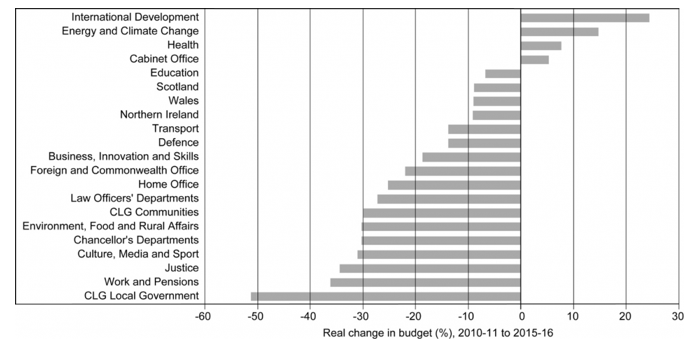
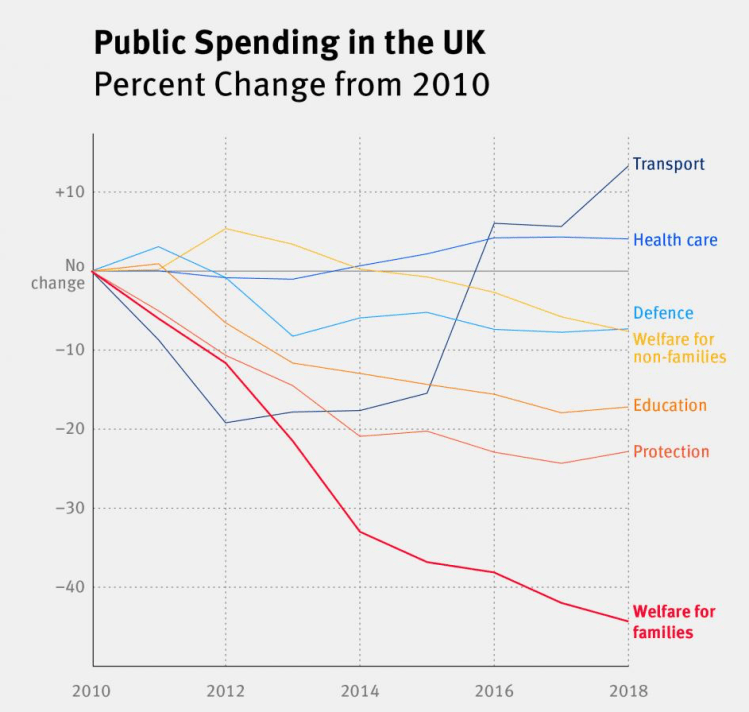
On the 14th April the Office for Budget Responsibility estimated the UK government may well need to borrow something in the region of £273bn this financial year to cover the costs of responding to Coronavirus. This would result in a deficit of around 14% of UK GDP[3].  At its peak, the deficit in the aftermath of the 2008 financial crisis reached 10%[4]. The UK Labour government at that time, along with many other national governments initially adopted a Keynesian policy response (essentially the opposite to austerity), with a £21bn fiscal stimulus, however on gaining power in the 2010 election, the Conservatives with the help of the Liberal Democrats reversed this policy agenda and adopted a crippling austerity regime. This saw the largest reduction in state spending since the Second World War and led to an increase of at least 800,000 children and 1.5 million working age adults falling into poverty. Far from us all being in it together as Conservative leader David Cameron couldn’t stop telling us at the time, it was the poorest 2/10s of the population who were the hardest hit[5]. In addition, austerity led to a decade of economic stagnation, rising living costs while incomes fell, and an increased unemployment rate for five years. Budgets across government were slashed, with local councils fairing worse, seeing average cuts of over 50%, with work and pensions next at 35%[6]. These are the budgets the most vulnerable in our society rely on most, and therefore it should sadly surprise us less that some have estimated the cuts accounted for around 130,000 preventable deaths as a result of the political choice to impose austerity[7]

[8]Local government and Work and Pensions were the worst affected.

[9]Budget cuts targeted those on which the most vulnerable were reliant.

Debt or deficit?

Considering such a high price was paid over such a long period of time, you’d have expected this bitterest of pills we were forced to swallow would have ultimately made us better. If so you’d be wrong, although you’d be forgiven for getting a little confused, as the architects of austerity (I suspect knowingly) often confused its two targets; namely the national deficit, and the national debt[10]

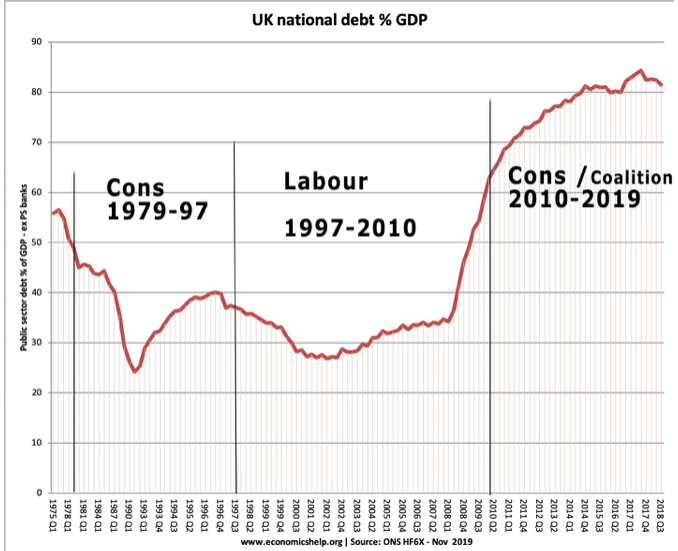
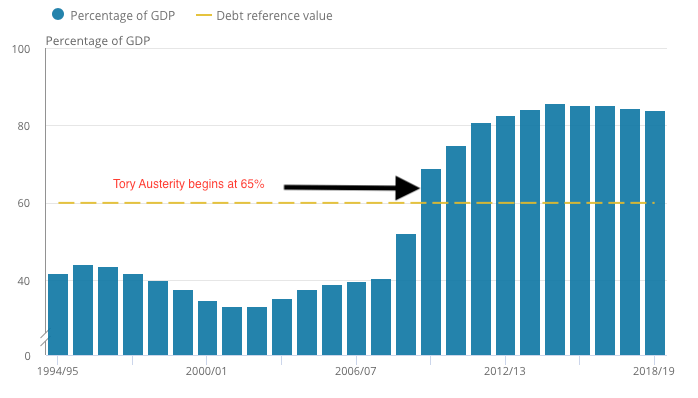
The former is the excess amount the government has had to spend above that which it brings in in revenue in any year. The government must raise this excess through borrowing. The latter is the total sum of government debt which has accumulated over time. Up until the financial crisis, this long run public debt had averaged around 30% of annual GDP during Labour’s tenure. As you can see from the graph below, contrary to Tory and Liberal Democrat claims that Labour’s time in office was characterised by profligate debt fuelled spending, they actually reduced the public debt from that inherited from the Tories on taking power in 1997. 

[11]Labour reduced the public debt they inherited from the Tories.

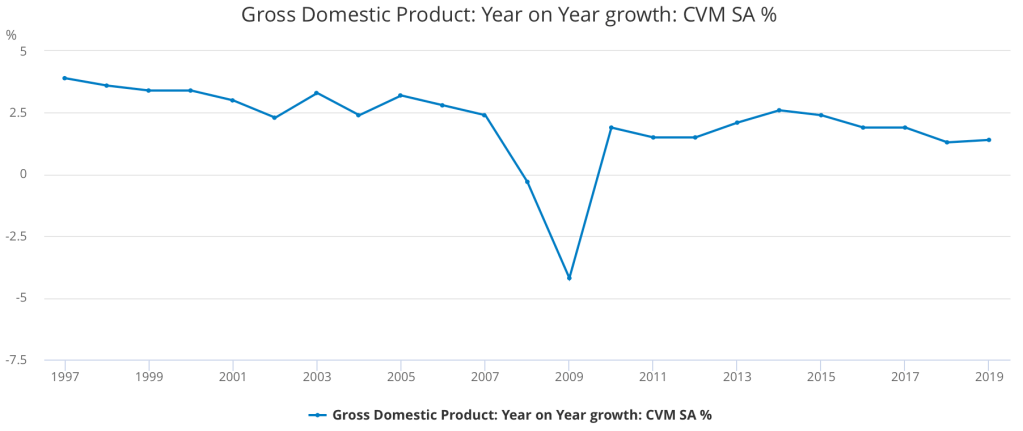
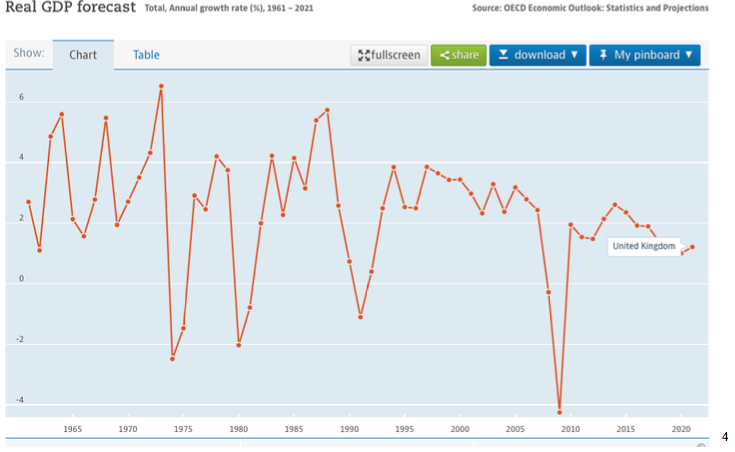
As the graph indicates, it was the cost of bailing out the banks in 2008 which initially forced the Labour government to increase their borrowing to shore up the banking sector by £136.6bn[12]. But besides this hit to the public purse, two secondary effects of the financial crisis further increased public debt: one is the increased demand in a downturn on automatic stabilisers such as welfare payments, whilst the other is that the downturn reduces the tax revenue the government is able to collect. Of course, one compounds the other, at just the time that government expenditure increases, so its income is cut through falling tax revenue. It is to counter these effects that Keynesian policy dictates that trying to cut a budget deficit during a downturn is precisely the wrong time. As demand in the economy is subdued, investors lack the confidence to invest, so undermining secure employment, and thus a negative feedback loop is set in motion. To counter this, governments need to step in and provide funding to the economy, financed through borrowing in order to stimulate demand and thus renew investor confidence. This in turn feeds through over time to once again increase government tax revenue by which to pay off the debts incurred by the stimulus. It was this policy framework which was initially adopted by most Western governments in 2008[13]. Through a combination of cuts to VAT and earlier capital investment spending, the Labour government effectively injected £21 billion (in addition to the bank bailouts) into the economy to stave off the worst excesses of the recession, resulting in the UK economy growing at a rate of 3.3% between autumn 2009 – autumn 2010. Once the Tory coalition took power the following year and imposed austerity, growth dropped to just 0.3% during that period[14]. It has remained sluggish ever since, growing on average only 1.6% over the last nine years, with the recovery officially the slowest on record, surpassing even the slump of the 1920s[15]

[16]Economic growth averaged only 1.6% per year over the last nine years.

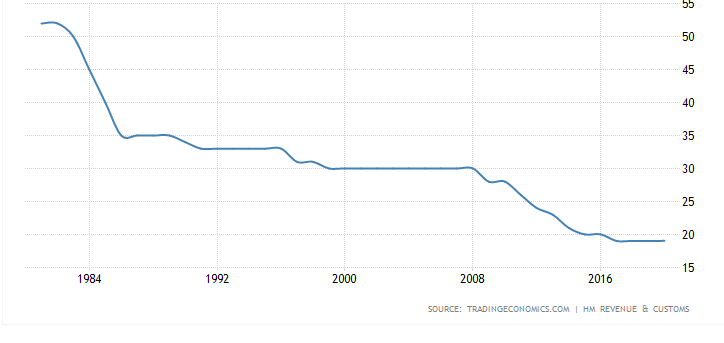
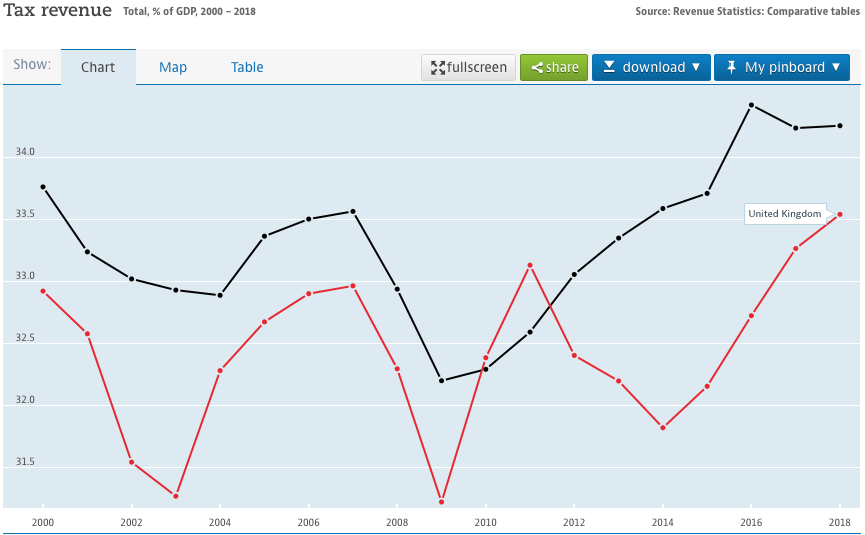
Such sluggish growth translates into lower tax revenue with which to pay off the debt, and therefore prolongs the period in deficit. This has been compounded all the more as the much vaunted ‘record’ fall in unemployment overseen by the Tories has been characterised by low waged, ‘flexible’ under employment, which is designed by employers to pay as little tax as possible. Whilst at the same time they have cut both the top rate of income tax from 50 – 45%, and corporation tax from 28 – 19%[17].  This was all the more reckless when you consider prior to the 2008 crisis, UK tax take had become too reliant on the finance sector, such that when it contracted, so did the taxes it paid to the Treasury. Reducing other sources of tax at such a critical time was driven by the misguided ideology that lower tax rates yield more in revenue. As you can see from the graphs below, it didn’t work.

[18]Corporation tax rates have been cut to their lowest rates on record.

[19]You can see the fall in tax revenue as austerity set in. The black line is the OECD average.

It is these dynamics which resulted in the deficit only being paid down at a rate of a mere 1% a year,[20] and therefore the size of government debt inflate from an average of 37% of GDP during Labour’s tenure up until the financial crisis – which then resulted in it increasing to 65% by the time the Tories came to power in 2010 – to still standing at 84.6% of GDP in March 2019, and predicted to rise above 100% of GDP consequent of Coronavirus.

Reframing the narrative

Despite both the Tories and Liberal Democrats backing the 2008 borrowing which was necessary to bail out the banks, a year later they had reframed the source of this debt as evidence of a profligate Labour government recklessly over spending during their time in office[21]. Reducing the public debt became the centrepiece of their 2010 election campaign, and the justification for their brutal policy of austerity. In his 2009 ‘Age of Austerity’ speech at the Tory party spring conference, then leader David Cameron claimed:

 “Labour are spent, the money has run out. Now some people say: let’s get through the recession, let’s get through the election we can keep on spending more, keep on borrowing more, and deal with the debt crisis later. Wrong – seriously wrong. The alternative to dealing with the debt crisis now is mounting debt, higher interest rates and a weaker economy. Unless we deal with this debt crisis, we risk becoming once again the sick man of Europe.  Our recovery will be held back, and our children will be weighed down, by a millstone of debt.[22]

 [23]    You can see how much public debt has risen because of austerity.

Not only did a decade of crippling Tory austerity plight the lives of millions of people, we can see from the graph above that even on its own terms it utterly failed to reduce the debt, instead almost doubling it in cash terms from £1 trillion – £1.8 trillion [24].  No wonder they were so quiet about the ‘debt’ during the 2019 election campaign.

Whilst Labour were compelled to increase the debt in order to bail out the banking sector, the increase under the Tories tenure is down to the complete failure of austerity policies. Whilst it’s true they eventually reduced the deficit, this was painfully slow and only achieved by brutally cutting the vital and hard-won public services of the most vulnerable in our society, rather than overseeing a growing economy able to deliver healthy tax revenues through which to pay off the deficit and rebalance the nation’s finances in a fair and humane manner. In fact, the New Economics Foundation calculated that austerity cost the UK economy around £100bn in lost economic activity, that’s a loss to every UK household of £300 a month for almost a decade[25].

Austerity: a political choice

The reframing of the debt and deficit as a result of profligate spending by Labour implied that the nation as a whole had enjoyed an unsustainable period of excessive government spending, rather than the actual truth that the debt, deficit, and recession were a consequence of the reckless excesses of the finance sector. Not only did the actions of this extremely wealthy minority cause the crisis in the first place, they were then able to protect their assets by having the state pay their debts, and then transfer the burden of responsibility for that debt on to those who had never even benefitted from the fruits of the excesses in the first place. 

In facilitating this, the Tories and Liberal Democrats made a political choice about the distribution of resources, rather than what they attempted dress up as choiceless economic necessity. They chose to target the lower to middle socioeconomic sections of society who are reliant on the direct and indirect state transfers to pay off those debts, whilst those who were actually culpable were given tax cuts, such is the perversity of austerity politics. 

It is worth remembering that these various state transfers that were cut did not just appear one day in the past because of the generosity of the wealthy. They are the product of long fought political battles that our forefathers struggled to gain. In so doing they stabilised capitalism and facilitated the expansion of a middle class, – a class political scientists will tell you is essential to a functioning democracy. It’s no exaggeration to say that the consequences of austerity can become very dangerous indeed. The recent rise of populism and nationalism should not come as a surprise; they are all too often the handmaidens of austerity. They are now, just as they were before WWII, but we’ll have to explore that historical aspect of austerity another time[26]

Another political element to austerity which is concealed by the cloak of ‘economic necessity’ is the legitimisation of the long run Conservative privatisation agenda. During the last ten years of austerity, over 20 state owned (or part owned) organisations were privatised [27]. Many of them disastrously so, such as the privatisations stemming from cuts to the Ministry of Justice which saw both the UK Forensics Science Service and the Probations Service sold off. Such was the unmitigated disaster of the latter it was recently renationalised, but only after a series of catastrophic blunders of the early release of very dangerous unreformed prisoners who went on to commit awful crimes[28]. Whilst privatisation of the FSS led to the recall of 10,000 criminal case samples, the biggest in British legal history after fears the data had been manipulated [29]. Add to those two the renationalisation (again) of the East coast rail line, and the collapse of Carillion after taking over many public service roles. The story is a familiar one; private failure, public rescue. But only that is, after the private sector has looted the company accounts and passed the hollowed-out debt ridden entities back to the state and onto the books of public debt. 

The ideological privatisation of these institutions was obscured by the austerity narrative, and the many who have suffered as a result of the failure of this process should be added to those already listed above. 

2020 is the new 2008

Although there is a case to be made that a pandemic arriving on our shores in the aftermath of ten years of brutal cuts to public services, and highest public debt since the Sixties, have almost certainly resulted in more economic pain than may have been otherwise necessary, and has certainly contributed to the number of lives lost, it’s true to say that unlike the man-made financial crisis, coronavirus is more an act of nature. This I’m sure will be weaponised to justify cuts ‘across’ society. But as we know from austerity, cuts to the state budget fall disproportionately on those in most need, they do not fall equally across society.  

Yet whilst the cause of this crisis may be more ‘natural’, many of the same fundamental dynamics at the root of the last bailout are apparent in this one. Not least a super wealthy elite who are happy to deride the state and avoid paying their fair share of taxes in the good times, yet as soon as a crisis arises, they seek the protection of the state to protect their almost obscene levels of wealth. Take for example two high profile claimants of public money. Sir Philip Green and Sir Richard Branson. Both have conspicuously avoided paying their fair share of taxes by storing their wealth in offshore tax havens, whilst their unscrupulous past business behaviour has already cost the UK taxpayer dearly. The former is not only infamous for asset stripping the BHS group and raiding its pension, only to then transfer its liabilities onto the UK tax payer, he has also paid his staff such low wages that the state has effectively subsidised his payroll through hundreds of millions of pounds in tax credits[30].  Whilst the latter controversially received a pay out from the NHS after his Virgin group complained about a tendering process. 

Of course, it’s easy to pick out two pantomime villains to express my point, but the broader fact remains; the corporate world, encompassing both the managerial elite and the business models they adopt, have embraced tax avoidance measures as a fundamental characteristic of both their personal and professional modus operandi. As we have noted above, it is precisely this type of behaviour which reduces tax revenues, and therefore hinders the reduction of the public debt. Yet despite this, the UK is the biggest enabler of corporate tax dodging in the world[31]

Definitely business must be supported during times of crisis, but surely in a just society this must be balanced with fairness. France and Denmark for example are sending a very clear message to their corporate sectors via the medium of state support, by only bailing out those businesses who are not paying out dividends or engaging in share buybacks during the crisis, or which are registered in tax havens[32]. It should not be business as usual while Rome burns. 

Unfortunately, and somewhat unsurprisingly, the ex-Goldman Sachs/hedge fund manager Chancellor Sunak, has sought no such conditionality for corporates to access UK state support, with Easy Jet paying out a £174mn dividend to shareholders just days before receiving a £600mn state backed loan[33]. But rather than address what is evidently a fundamentally flawed business model, the ex-Goldman Sachs/hedge fund manager Chancellor, and the Bank of England, have sought to shield themselves from public scrutiny by imposing confidentiality agreements surrounding their actions[34]. All we know so far is the ‘Covid Corporate Financing Facility’ has already paid out £7.4bn, yet it is only accessible to huge investment grade corporations. Whilst it’s true these account for 40% of UK employment, small and medium size enterprises account for over 60%, yet by last week they’d only received around one seventh of the support these tax avoiding corporate giants had received[35].  These are vast amounts of public money which are being spent with no transparency, and which no doubt later will be bundled together with the rest of the ‘public’ debt and presented to us as the ‘cost’ of paying for the Coronavirus. A cost which as we have seen before is burdened on the shoulders of those least able to bear it.

Who exactly is the utopian? 

Proponents of austerity are ideologically wedded to a neoliberal worldview of markets as inherently naturally equilibrating. In their simplistic world, savings are never hoarded, but rather always flow into investment, which in turn stimulates employment and thus wages, driving up consumption which leads to profits, and ultimately back round to reinvestment again. All functioning like a finely crafted Swiss watch. The problem is that at the best of times it doesn’t much work like that, but completely malfunctions during a downturn, when investors are reluctant to invest as they don’t feel there’s sufficient demand in the economy. In this event, the more rational action is often to hoard savings. It’s known as the paradox of thrift. As we noted at the beginning of the article, if everyone does this at the same time, no one is spending and thus consumption falls. This can then lead to more unemployment and even less consumption and so on in a downward spiral. Such a subpar level of economic activity can continue for years, and it is in seeking to avoid this that Keynesian economics starts with stimulating demand via the capacities of the state to ‘jump start’ the economy. Neoliberals however consider such ‘interference’ in the economy runs the danger of crowding out private investors who’ll be reluctant to compete with the state. They think it’s better in a downturn to just wait and let markets (such as wages) find a new more competitive (lower) level. In effect, don’t try and buck the market and accept that wage rates are always at the mercy of markets finding their right equilibrium. Essentially, if only everyone accepted their lot and conformed to the dictates of the market, then the messy business of politics wouldn’t interfere in the smooth functioning of the economy. The problem is that in democracies, people generally begin to push back against such insecurity in their lives.  It is to this end that neoliberals have sought to insulate the economy from ‘democratic’ politics; the austerity narrative of a choiceless economic ‘necessity’ being a perfect cloak.

That however is not to say that being shielded from ‘democratic’ political pressure equates to an absence of political motivation behind austerity. On the contrary, as the relative impact of austerity on different socioeconomic groups highlighted earlier in the article exposes, the economic choices themselves are actually the very definition of political. Different economic theories empower and disempower different socioeconomic constituencies. Austerity and the neoliberal theory on which it’s premised is what’s known as ‘supply’ side, meaning that the state works more in the interests of the wealthy, the suppliers of goods and services, for example by cutting taxes and reducing employment regulation. This is in contrast to Keynesianism, which is known as ‘demand’ side as it focuses on stimulating demand in the economy by increasing the consumption of the less wealthy, for example by providing welfare payments collected through taxation.   

When you start to unpick the economic logic and unrealistic assumptions of an economy void of political reaction to negative market effects which underpins the reasoning behind the austerity agenda, you can begin to see it as ridiculously utopian. Yet despite this, austerity proponents dress up their utopian aims with seemingly simple truths such as ‘you can’t reduce debt with more debt’, which can have an instinctive appeal, especially on the micro individual level that we generally view the world. Yet on another level, we all know through our lived experience – right now with Coronavirus being a good example – the world does not run smoothly like the well-oiled machine of neoliberal dreams. Crises abound, economics is politics is economics is politics. We are no more able to reach the utopian Shangri-La of neoliberalism, than we are those of any other ideology neoliberals tell us are unrealistically utopian, and thus in the meantime we are compelled to deal with the reality of crises as they present themselves. We cannot, as the proponents of austerity seek to force us, just keep putting our lives on hold for decades whilst we wait for markets to ‘naturally’ find their equilibrium, they don’t, and then another crises comes along anyway. As Keynes reminded us, ‘in the long run we are all dead’. Therefore we need to be able to live and prosper in the context of a large public debt, whilst gradually reducing it through an equitable tax system and thriving economy. 

Shock horror, you can actually live with debt

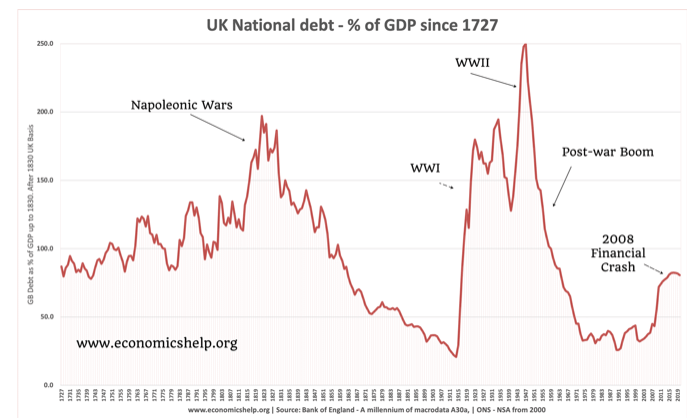
The rather inconvenient truth that austerity proponents ignore, is that following the Second World War the UK had a debt to GDP ratio of close to 250%. Not only did we slowly reduce this down to around 30% of GDP by the end of the Sixties, we did so whilst setting up the NHS and the welfare state, all of which contributed to the economic activity through which the debt was paid down. Such was the economic and political stability of the period, it became known as the Golden Age of Capitalism.

One of the most fundamental differences between then and now is that the state played a much more active role in the economy, efficiently collecting taxes, and ameliorating the worst excesses of the market. Forty years of neoliberalism have left us with a very different relationship with the state, but history has shown us that what appears impossible one day, can often be inevitable the next. We don’t have to be encased in another neoliberal coffin, enduring endless rounds of austerity grinding society ever further down. We have choices. 

[36] Capitalism’s most productive and socially beneficial period happened in the context of a large public debt.

As many Keynesian economists have proposed, there has perhaps never been such a critical time in which we need to reorient our perception of the economy and the mainstream ideas through which we govern it. 

The climate crisis has been compared to Coronavirus in slow motion. Both demand we reassess our perception of value and efficiency. Both cannot be addressed through the institutional framework of neoliberal capitalism. 

In similar fashion to the stimulus that post-war reconstruction gave to the UK economy in the years following the war, so could state directed investments in a Green New Deal[37]. It could both help reduce our carbon emissions, whilst also providing well paid employment through which to gain the tax revenue to pay off the debt. Principal to this though would be replacing the UK’s current sieve-like tax enforcement, so that a fair proportion of the revenue generated can be ploughed back in to paying off the debt. The current system is nothing short of the crony capitalism that we so often accuse those in less developed countries of engaging in. As Ann Peitifor, one of the architects of the Green New Deal has highlighted, off-shore tax havens are stuffed full of somewhere between $8-35 trillion dollars of unproductive capital, currently out of the reach of tax authorities[38]. As noted earlier, that the UK is the biggest enabler of corporate tax dodging in the world, makes our government supremely empowered to address this. The fact it doesn’t reveals both the lie that austerity is all about balancing the books, and exposes its raw political motivations in serving the interests of the wealthy. After all, why is it that arguments around efficiency are always wheeled out when it comes to cutting the public services, but when it comes to collecting the tax revenues through which they and the public debt should be serviced, the Tories have no such rigour in ironing out inefficiencies?

Zombie amnesia? 

So to conclude, the Tories came to power in 2010 saying that a period of austerity was needed to pay down the national debt. It didn’t work and the debt is now almost twice what it was. Yet ten years later with an even greater debt than when it started, the architects of this failed project have the audacity to still claim that we need even further austerity cuts than the ones they instigated and from which our public services have yet to recover, in order to…….reduce the debt. It’s part zombie mentality which sees them chained to an economic ideology which fails to correspond coherently to reality, part contempt for the public intellect, knowing that with the help of their tax avoiding owners, much of our mainstream and social media will help reframe economic reality to suit their agenda. But as this article highlights, you really don’t need to look too hard to see the economic inefficiency of austerity policies. And that’s aside from their negative social and political impact. The Tories however, with their callous disregard for the vulnerable, seem content to accept this subpar economic world. Happy to use the deficit narrative as a cloak from which to obscure the undemocratic underpinning of the neoliberal ideology they embrace, to push private sector interests further into the domain of public services.

Of course a new round of austerity almost certainly won’t be called a new round of austerity once the crisis is over. I imagine the likes of Dominic Cummings are already dreaming up snappy three word slogans they can use to distract the public from the actual reality that it’ll be their public services disappearing. ‘Cuts For Control’ or ‘Get the Deficit Done’ maybe?

But whatever they call it, we can be certain that undertaking another round of budget cuts when so much of the damage the last ten years of austerity has wrought on society still remains would truly be a horror film for many in our society, and without doubt open even greater sores than the divisions brought about by Brexit. I do hope politicians and public alike can see the dangers of this zombie ideology lurking in the shadows, and drive a steak through its cold undead heart once and for all. The future is ours to make, let’s reinvent it anew.


[1] https://www.bloombergquint.com/global-economics/architect-of-u-k-austerity-says-retrenchment-needed-post-crisis

[2] https://www.tuc.org.uk/sites/default/files/ThePriceofAusterity.pdf

[3] https://www.bbc.co.uk/news/business-52279871

[4] https://fullfact.org/election-2019/ask-fullfact-debt-deficit/

[5] https://www.bbc.co.uk/news/10393585

https://www.ifs.org.uk/publications/5711

[6] https://www-cdn.oxfam.org/s3fs-public/file_attachments/cs-true-cost-austerity-inequality-uk-120913-en_0.pdf

[7] https://www.theguardian.com/politics/2019/jun/01/perfect-storm-austerity-behind-130000-deaths-uk-ippr-report

[8] https://blogs.lse.ac.uk/politicsandpolicy/the-uneven-geography-of-austerity/

[9] https://www.hrw.org/report/2019/05/20/nothing-left-cupboards/austerity-welfare-cuts-and-right-food-uk

[10] https://www.channel4.com/news/factcheck/cameron-busted-on-debt-claims

[11] https://www.economicshelp.org/blog/7568/debt/government-debt-under-labour-1997-2010/

[12] https://cdn.obr.uk/March-2019_EFO_Web-Accessible.pdf#page=143

[13] https://www.ilo.org/wcmsp5/groups/public/—dgreports/—inst/documents/publication/wcms_194175.pdf

[14] https://www.theguardian.com/commentisfree/2012/feb/06/gordon-brown-save-world-uk

[15] https://www.independent.co.uk/news/business/analysis-and-features/uk-economy-latest-updates-feeble-recovery-record-spring-statement-ifs-recession-philip-hammond-a8255756.html

[16]https://www.ons.gov.uk/economy/governmentpublicsectorandtaxes/publicspending/bulletins/ukgovernmentdebtanddeficitforeurostatmaast/december2019

[17] https://www.newstatesman.com/politics/uk/2017/11/how-tax-cuts-rich-have-cost-country-dear

https://www.ft.com/content/30238556-2322-11e9-8ce6-5db4543da632

https://www.ifs.org.uk/publications/9207

[18] https://tradingeconomics.com/united-kingdom/corporate-tax-rate

[19] https://data.oecd.org/tax/tax-revenue.htm

[20] https://www.bbc.co.uk/news/business-39897498

[21] http://news.bbc.co.uk/1/hi/uk_politics/7658518.stmhttps://www.telegraph.co.uk/finance/financialcrisis/3108477/Financial-crisis-David-Cameron-tells-Tory-conference-he-will-work-with-Gordon-Brown.html

[22] https://conservative-speeches.sayit.mysociety.org/speech/601367

[23]https://www.ons.gov.uk/economy/governmentpublicsectorandtaxes/publicspending/bulletins/ukgovernmentdebtanddeficitforeurostatmaast/december2019

[24] https://fullfact.org/economy/public-debt/

24 https://www.theguardian.com/business/2019/feb/21/uk-economy-100bn-smaller-because-of-austerity-thinktank

[26] Blyth. M, (2013), Austerity: The History of a Dangerous Idea. OUP Oxford

[27] https://en.wikipedia.org/wiki/List_of_privatizations_by_country#2010s_2

[28] https://www.theguardian.com/politics/2019/jun/30/chris-grayling-probation-privatisation-disaster

[29] https://www.theguardian.com/public-leaders-network/2017/nov/27/dubious-forensic-evidence-privatisation-public-services

[30] https://www.theguardian.com/commentisfree/2016/jun/15/philip-green-bhs-tycoon-tax-parliamentary-inquiry

[31] https://www.independent.co.uk/news/business/news/uk-corporate-tax-avoidance-havens-justice-network-dodging-a8933661.html

[32] https://www.bloomberg.com/news/articles/2020-04-18/denmark-extends-business-aid-to-increase-spending-by-15-billion

https://www.ft.com/content/c6bf2a72-e2c0-43cc-94af-35e998bf81fa

[33] https://www.thetimes.co.uk/article/easyjet-seeks-state-loans-but-pays-stelios-60m-d26jghjtx

[34] https://www.thelondoneconomic.com/business-economics/call-for-veil-of-secrecy-to-be-lifted-as-5-5bn-public-money-spent-bailing-out-big-business/10/04/

[35]https://positivemoney.org/2020/04/bank-of-england-provides-7-5-billion-in-big-business-bailouts-all-hidden-from-public-view/

https://www.theguardian.com/business/2020/apr/15/covid-19-bailout-loans-issued-uk-firms-banks

[36] https://www.economicshelp.org/blog/163755/economics/historical-uk-national-debt/

[37] Pettifor. A, (2019) The Case for the Green New Deal

[38] https://www.taxjustice.net/2020/03/27/could-the-wealth-in-tax-havens-help-us-pay-for-the-coronavirus-response/

The Ironic Mr Cummings

As H.P. Lovecraft once observed: “From even the greatest of horrors irony is seldom absent.” 

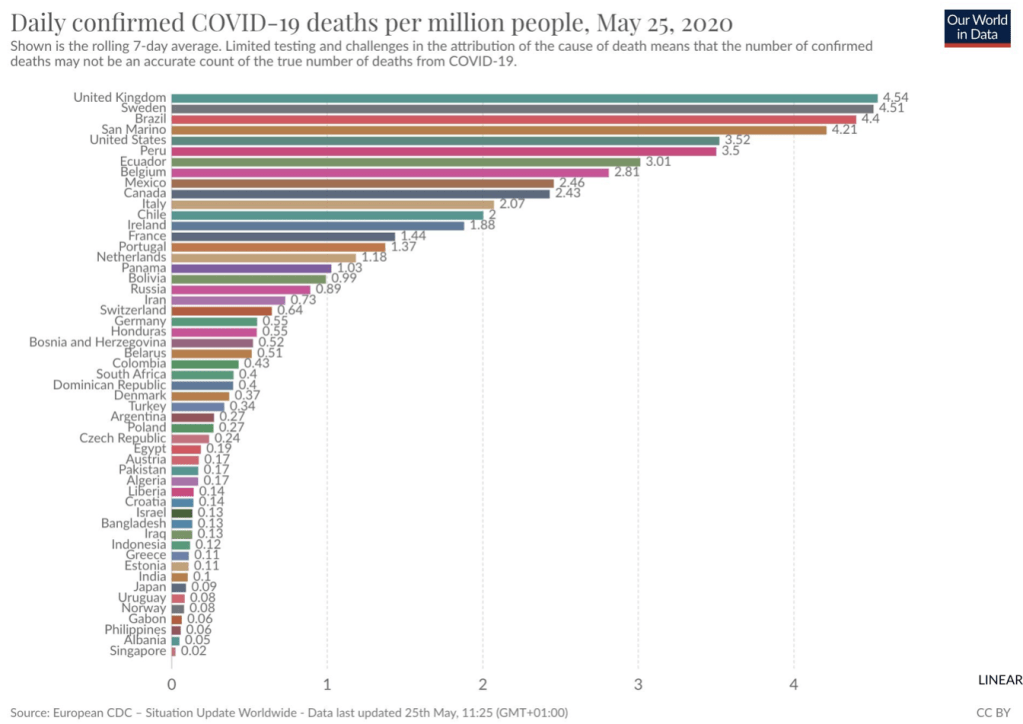
And so it is that in the week the Tory government finally made us world leaders….in death, as we took the unenviable title as the country with the highest death rates per capita in the world, our collective horror has indeed been joined by a very large measure of irony. 

Never trust an unelected bureaucrat eh?

This large dose of irony has been served in the form of one unelected bureaucrat who has made a career railing against the power of, you guessed it, unelected bureaucrats.  I am of course talking about Dominic Cummings, the man who has been revealed this week as our co-prime minister. Whilst many suspected he held this position from the moment Boris Johnson took office, it was confirmed for even the sceptics as he held his very own press conference at No.10. This involved him trying to wriggle out of the untenable position he’d placed himself in as a consequence of an excess of arrogance, which had led him to think he didn’t need to follow the ‘universal’ rules he himself had designed. Given the context, such an event in which an unelected bureaucrat has been afforded a platform at the heart of power in one of the world’s oldest democracies is itself without precedence. However, making it abundantly clear for those not paying attention, this was compounded by the ‘protective ring’ Mr Johnson then threw around Mr Cummings, which highlighted further that such was the importance of this unelected bureaucrat in governing our sovereign democracy, that Mr Johnson was not only willing to accept considerable damage to his own reputation and leadership, and that of the government and Tory party more generally, but was even willing to risk yet further damage to the public health strategy in place to tackle Covid19. It was already evident that Mr Cummings’ actions had eroded the clarity of the public health messaging, and his failure to apologise really did undermine it further. As ministers were unable to contradict what he had done, they had to leave open the possibility of 500+ mile round trip journeys for anyone whose ‘instinct’ told them this was the best thing for them to do…..in a lockdown. As if this wasn’t bad enough, in an attempt to deflect the criticism away from his partner in crime, the other prime minister Boris Johnson, then altered the lockdown restrictions, and thus I suspect brought about the premature death of whoever is unfortunate enough to catch the virus as a consequence of playing so fast and loose with public health strategy in the middle of a deadly pandemic. Worse still, it didn’t even work, with 59% of voters still thinking Mr Cummings should resign[1]

So just to recap; the unelected bureaucrat who gained power by railing against unelected bureaucrats, takes an unelected pivotal position in the seat of power from where he designs rules for the masses which he does not follow himself.  This has the effect of diminishing the efficacy of the original public health strategy in responding to Covid, however regardless of the human cost, the strategy itself is then altered in order to distract attention away from the democratic pressure which sees a large majority of the UK population wanting this unelected bureaucrat removed from office. As examples of irony go, this would surely make Alanis Morrissette excited. 

The cult of Cummings?

Now a reasonable person might expect that those who voted for Brexit might feel somewhat betrayed by such actions. Even more so if they were to discover that this unelected bureaucrat is also in possession of two other identities they claimed were the aim of their ire when voting for Brexit; the establishment and the elite. For it is hard to argue that a man who comes from a very wealthy background, whose uncle was a knight of the realm and a Lord Chief Justice of Appeal, and whose wife is the daughter of Sir Edward Humphry Tyrrel Wakefield 2nd Baronet; so literally an aristocrat, is anything other than an elite member of the establishment. It is therefore somewhat puzzling at first thought that far from rejecting this man as the epitome of all that they were voting against, a not insignificant demographic rejects the evidence before their eyes, and actually vociferously defends this unelected bureaucrat in the face of an overwhelming majority who call for his dismissal. However, it is from such an apparently illogical outcome that we can see why Boris Johnson is reluctant to get rid of Mr Cummings. For whilst his skill set clearly doesn’t include much in the way of common sense, it does include an ability to manipulate the perceptions of certain demographic groups, such that they will ignore the reality in front of their eyes, engendering an almost cultist tribalism amongst those he has managed to get his messaging hooks into. 

Facebook stole our democracy

He of course honed these skills during the EU referendum, where with the help of Facebook’s Mark Zuckerberg, he and his elite cabal centred around the multibillionaire Robert Mercer and his company Cambridge Analytica, were able to mount a widespread campaign of disinformation. To a very large extent based on untruths, the welter of false claims that were made, often utilised the concept of ‘dark advertisements’ in which a Facebook user is micro targeted with specific adverts which their profile suggests will gain traction with them, but which are destroyed once read, such that no democratic opportunity is available to counter any false claims they make[2].  Add to this the illegal use of private data and systematic campaign overspending and you see a picture emerge of the patently undemocratic measures that Mr Cummings & Co are willing to engage in to win elections. It is of course supremely ironic to trash democratic norms in the ostensible pursuit of regaining democracy, but irony is somewhat of a forte for this lot. 

Similar behaviour won them the 2019 election, with a widespread disinformation campaign orchestrated by Cummings et al which was almost void of any positive messaging about what programme of government the Tories would pursue if victorious, beyond “Get Brexit Done’. Instead, both the formal campaign and the opaque online campaign focused almost entirely on creating a negative portrayal of the opposition, with the online Facebook campaign seeing scores of fake grassroots campaigns able to make completely false claims about the opposition, but which were unable to be challenged formally as they were so numerous and one step removed from the formal campaign.  

Beyond the almost exclusive focus on this manipulative and deceitful messaging, is the second element of their strategy, which is identifying the demographic most suitable for their tactics.  Then in areas of low opposition majorities, focusing lots of resources on swinging these marginal voters, safe in the knowledge that the smear campaign directed against the opposition will keep the Tory faithful onboard, even if they’re not particularly comfortable with the direction of travel, whilst simultaneously the negative narrative works to create disaffection amongst those who are unlikely to vote Tory. In an age when voter turnout is historically low, targeting very precise groups in specific marginal locations can be just enough to push your side across the line. This is especially so when multiplied at the national level. 

The Cumming(s) Storm?

Nonetheless, considering that Dominic Cummings’ speciality seems to be centred around messaging/campaigning, and yet we aren’t due a general election for at least four years, the question is rightly asked; why is Boris Johnson prepared to take such a hit now to protect Mr Cummings?  I think the answer is that the Boris Johnson Brexiteer administration has a very high expectation of a coming storm at the end of this year when a no-deal Brexit will have to be pushed across the line, come what may. Mr Cummings and his dark arts I imagine are seen as an essential component of the strategy to maintain power and keep that core demographic onboard during the predictable upheaval that will ensue. Peddling in falsehoods, engendering division, avoiding scrutiny and generally diverting attention from criticism has been so essential to the success of this cabal so far, they’re hardly going to give up the chief architect of this strategy six months or so before the next, possibly most damaging chapter of their project.  

The last few months have already given us a snapshot of their Orwellian gaslighting strategies in which they attempt to rewrite history; such as the claim made by Boris Johnson in PMQs that they had not advised hospitals to discharge Covid infected elderly people back to care homes, when they had done exactly just that, as was evidenced by their own official advice from the time. Or that they had put a protective ring around care homes from the very beginning, a statement which was met with incredulity by the nations’ care homes. This gaslighting strategy is paired simultaneously with attacks on the media, who are denigrated as biased, if ironically they are not biased, and dare to actually tell the truth. In yet another nod to the God of irony, during Mr Cummings press conference, he accused the public of being misled by stories in the media, yet not only was he there, pretty much confirming they were all true, the one media report which was indeed completely out of the ball park was the article written by his wife about their period in ‘London lockdown’.  The #mediascum which quickly sprang up to intimidate those who dared to report the truth regarding Mr Cummings’ sojourn to Durham is one such example of this tactic.  

Where’s my fridge?

What is abundantly clear is the contempt in which this elite group hold democratic norms. After all, Dominic Cummings was literally found in contempt of parliament for failing to appear before a select committee investigating fake news[3]. Add to this the proroguing of parliament, the constant attempts of the prime minister to hide from scrutiny, be that in parliament or in the media (remember fridge-gate?), and the farce which have become the daily press conferences, in which journalists are refused to ask searching questions, and if they do manage it are fobbed off with bluster and non-answers.  

All these undemocratic actions point to a government which sees the democratic norms of the country as not only an inconvenience, but worse, as they’re an opportunity to be held to account, they’re seen as a dangerous threat, as scrutiny of their actions will reveal their administration is essentially just a PR/messaging project largely based on untruths – and taking us out of the EU with no-deal. That’s why their 2019 manifesto was pretty much empty of any plan for government. As it was Mr Cummings and his dark arts which got them into power despite being void of a plan for government, they are therefore extremely reluctant to be without Mr Cummings over the coming months. 

Stop the ride I want to get off

For how long this charade can continue I suspect will be determined by the severity of what I fear will be an inevitable second wave of Covid. If death rates increase significantly or even just stubbornly refuse to fall, this will continue to have a catastrophic impact on the economy. If this happens whilst our European neighbours are slowly getting back to normal, the contrast between the UK as a seeming Covid basket case within Europe may be too much to bear, even for the relatively spineless backbench Tories. On the other hand, if we have passed the peak and we can slowly start getting back to ‘normal’, I suspect as per this article, Mr Cummings and his dark ways will be in our lives for a long time yet to come. 


[1] https://yougov.co.uk/topics/politics/survey-results/daily/2020/05/26/3fb8f/2

[2] https://www.joe.co.uk/news/brexit-facebook-adverts-192164

[3] https://www.theguardian.com/politics/2019/mar/27/commons-report-rules-dominic-cummings-in-contempt-of-parliament

Will the Coronavirus Crisis Help Us See More Clearly?

Most people have encountered Rubin’s vase at some point in their life. Initially you see one clear image, but then another image is perceived at the expense of the first. Once both images are apparent, their imprint on the memory is such that the image will never be observed as it first was, the brain constantly able to switch between the two from then on.

The effect this illusionary picture has on the viewer’s perception is analogous to what in psychology is known as gestalt switch, or in science more generally as a Kuhnian paradigm shift, named after Thomas Kuhn whose seminal work The Structure of Scientific Revolutions identified the uneven development of science over time. Both relate to a radical and critical shift in the perception of a previously accepted systemic framework through which we interpret and make sense of the world. 

Such a concept could be helpful in the coming months as the impact from the coronavirus has the capacity to lead us to fundamentally reassess the prevailing individualistic value structure that neoliberalism has constructed. From completely upending economic orthodoxy with the greatest level of state intervention in the economy since the Second World War, to a renewed understanding of the importance of public services and respect for the value that precarious low-paid workers bring to society, the coronavirus pandemic has the capacity to radically transform our society. 

There Is No Alternative. So goes the conditioning mantra which always underpins the arguments of the neoliberal naysayers who tell us the dysfunctional status quo is the only game in town. Yet in the space of a couple of weeks we have witnessed both how dysfunctional the system is, but also how much power the government has to intervene to rectify economic and social dysfunctions. In an instant, this crisis revealed the fallacious concept of the magic money tree to be nothing but a farce, a deceitful rhetorical tool used to debase the arguments of those trying to rectify the systemic problems of the status quo. Just as during the 2008 financial crisis, when banks and business are under pressure the government is always on hand to provide the necessary funding; for them, There Is Always An Alternative. Yet when nurses and other public sector workers are desperate for a pay rise, neoliberal Tory governments always claim they are demanding unicorns.

It is increasingly clear that economic shocks which affect the establishment always justify massive state bailouts, yet the general persistent economic and social dysfunctions which characterise neoliberal capitalism must be left to fester, neglected from state intervention. We are told this is necessary in order to not distort the naturality of the free market, however incidents like these crises when the state intervenes on an epic level, display in sharp relief that the market is neither autonomous nor inherently spontaneous or natural, and is in fact a social construct, bounded by a legal framework designed by legislators, and underwritten with tax payers’ money by the state. Those with more influence on those legislators and the state are able to use their power to mould the market to their needs. This influence is brought to bear through their economic power within society and is contrasted with the political power the masses have over the state. Of course, the key component of neoliberalism is the insulation of the economic from the political, legitimised under the illusion of a free market that must be protected from the influence of that democratic political power which is portrayed as a hindrance to the efficient functioning of the market.  Yet these crises clearly reveal that far from the state being a burden on the market, it is in reality both the bedrock and designer of the market.  In so doing they reveal the neoliberal discourse which promotes a narrative that the (political) state is a burden on individuals and should be limited – whilst all the while mining its resources for their own ends – is a deception through which to disarm the public of the immense democratic power they hold to model the market on the needs of society, rather than global capital. 

Paralleling the crisis’ capacity to reveal the vacuity of neoliberal assertions in respect of the relationship between the state and the market, it also has the capacity to redefine the prevailing social value structure. Whilst bankers and their ilk used to be keen on calling themselves ‘masters of the universe’, the 2008 crisis exposed this to be another conceited neoliberal discursive trick which helped frame a narrative that their actions were somehow sublime, rather than the parasitic Ponzi scheme which the crisis revealed much of it to be. The coronavirus has taken this devaluation of the neoliberal value structure a significant step further, with the elevation of the social value inherent to much low paid work. When society as whole is in critical danger, we can see it is not the super remunerated finance sector which keeps us alive, but rather the low paid, providing essential services to the life support systems of society; the food chain, public services etc.

The crisis has revealed the government has always been cogniscent the welfare system is not fit for purpose. As soon as a majority of the electorate needed to use it and therefore experience what many long term sick and disabled have to try to live on day to day, the government admitted that payments are both not enough to live on, and accessing them takes too long. Demonstrating the strength of political power, as this is an electoral threat, the government, have not only made the system (temporarily) more generous, but have undertaken an unprecedented programme of employee wage subsidisation. In turn this revealed the precarity of the self-employed, especially those atomised workers in the gig economy who so many of us are reliant upon. Whilst eventually the government even had to intervene to provide funding for them, it yet again laid bare both the inequities in the system and the capacity of the state to intervene.    

One of the clearest actions pushing on a gestalt switch that the crisis has compelled has been the virtually overnight ability of the government to take action on homelessness. Almost at the stroke of a pen, government has ordered an end to the homelessness crisis, thereby exposing the callousness of their previous inaction.   

But the most fundamental change, and one which will be very difficult for future governments to unpick will be the reassessment of the value of our public services such as the NHS. Having already endured ten years of neoliberal austerity which demanded endless cutting of public services in order to keep the tax bills low for global capital, this crisis has exposed how antithetical this logic is to society, leaving it extremely vulnerable in the face of crises. And whilst we don’t yet know what further disruption to the status quo the response to coronavirus may bring, what seems clear already is that it has enriched the value of the collective and impoverished those of excessive individualism. 

These various aspects of  the response to coronavirus hold the capacity to fundamentally reorient society away from the excessive individualism which has been promoted by the neoliberal project. In a similar way as Thomas Kuhn identified that the development of science is not a stable piecemeal process, but rather is punctuated by periodic revolutions in which the status quo paradigm becomes increasingly unable to provide a resilient coherence in the face of competing ideas, such that it increasingly loses its legitimacy, so the response to coronavirus represents a fundamental challenge to the existing neoliberal paradigm. For not only does the coronavirus crime scene have neoliberalism’s fingerprints all over it, in respect of underfunded public services struggling to respond, virus hotspots linked to areas of deprivation, and outsourced manufacturing resulting in a lack of quick access to essential equipment needed to fight the virus, to name but a few, the necessary responses which have had to be put in place are premised on socialist principles of collectivity; the antithesis of neoliberalism. And whilst these aspects of the crisis already represent a challenge to neoliberalism, these are likely to become a lot sharper if the death toll in Western societies is considerably higher than those in the East. The legitimacy of neoliberalism was already on life support following the financial crises and the ten years of austerity it dictated society must suffer as a consequence, but this crisis should delegitimise the paradigm once and for all. 

Over the last ten years especially, but stretching right back forty years to the beginning of neoliberalism, it has dictated that the state must be shrunk in order to protect individual (economic) freedom, that the private sector, via a competitive market is the most efficient way to organise society, that workers must be individualised, and that our ability to fund public services and invest in the nation should be hostage to the sentiments of global capital markets, for these we are told are more rational than the actions of politicians responding to democratic demands. 

Yet once the dust begins to settle after this crisis, how can any of those tenets still be held legitimate?  Even during periods of perceived stability when the neoliberal system delivers for the wealthy, it produces multiple crises for wider society and the environment, but when it engenders wholesale system failure as in 2008 and now during the coronavirus, not only is it unable to offer any resolution on its own terms, it is its antithesis, socialism and the principles of collectivity which are the most efficient way to respond. Surely a paradigm which fails on its own terms and which needs to be rescued by the ideas of its smeared opposite is unsustainable?

Without doubt once a vaccine has been developed those who benefit from the neoliberal system will push back to try preserve the status quo and reorient the narrative back to the virtues of individualism. Through their elite funded think tank mouth pieces at Tufton St and the like, they will try to smear the collective principles which are self-evidently pulling society through this crisis. Yet I imagine this will not be as easy a task as it once was. A gestalt switch may well have been perceived in the public’s consciousness. They can see that far from collective values being a threat to their individual freedom, they enable them. The neoliberal weaponizing of individualism was always a strategy to atomise us from each other and thereby disempower our collective control over society. This crisis has revealed yet again it is a fraudulent philosophy and the tenets on which it is premised are false and antithetical to society. When the crisis is over it will be very difficult for any government to engage in another period of prolonged austerity, especially in light of the reoriented social value hierarchy mentioned above which has elevated the standing of public services.  Therefore there will have to be a reckoning; either we endure another era of austerity politics and global markets dictating emasculated public services, or we scuttle neoliberalism on the rocks it has washed us onto once again. 

Incompetence and Ideology Yes, but Is There Also a Dog Whistle in Johnson’s Coronavirus Response?

Finally the prime minister enacts some fairly unequivocal measures and orders a lockdown of the UK. Across the country a collective sigh of relief was exhaled. 

In comparison to other countries’ response to Covid 19 we are second only to Italy for the number of deaths from the virus before imposing a lockdown. A troubling statistic indeed, especially considering Italy has almost twice the number of critical care beds than the UK. 

The government has been behind the curve on the public’s response to the crisis the whole way. Rather than No10’s ‘nudge unit’ stealthly manipulating our behaviour, it seems rather it has been society’s response which has been nudging government policy. From the u-turn on herd immunity, the sporting industry cancelling events prior to government advice, to polling last week which revealed a 52 – 26 percent margin in favour of declaring a state of emergency. The government has consistently appeared to be playing catch up with public sentiment. 

This has largely been blamed on a mixture of incompetence and a lack of preparedness, from a government and political party which is much more comfortable cutting the necessary public services that are vital for an effective response to the virus than investing in them. Whilst these are both undoubtedly true, could there also be a third, somewhat more discrete element at play?

Boris Johnson is known to be a self-serving politician, whose political leanings and relationship with the truth are dictated by what’s in his best interests, rather than those of the country – or political party for that matter. This was best evidenced by his initial ambivalence on the Brexit referendum, but has been a conspicuous character trait throughout his career. Facilitating this self-serving shape shifting, has been his newspaper columns from where he’s engaged in a constant stream of dog whistle politics. A platform which at once can send a wink and a nod of agreement to a more extreme right-wing fringe, via an often not so subtle use of language, whilst by appealing to a writer’s ‘journalistic flair’, ‘colourful language’ or ‘artistic licence’ (choose your excusatory phrase), allows him to distance himself from overt, clear public endorsement of the more extreme right-wing elements in society.  In so doing he’s able to capture this electoral demographic, whilst with the help of the mainstream media’s lack of interrogation on such issues, is also able to project a more acceptable moderate image, peculiarly aided by a sort of lovable buffoonery which endears him to a more centre-right demographic.  

From an electoral perspective this strategy is very effective. Whilst voter turnout at general elections averaged around 75 percent  from the onset of universal suffrage in 1922, once New Labour adopted much of the neoliberal philosophy driving Thatcherism, voter turnout significantly declined as the difference between the two parties lessened. This decline however was starkly reversed around the time of the Brexit Referendum, which through the manipulation of issues around identity and targeted dog whistle politics, re-engaged a significant margin of the electorate to the right. In the context of a stagnant mainstream centrism, which recoils at even moderately social democratic reforms from Labour, this re-engaged, identity focused demographic is the critical margin necessary to get the Tories across the line in our first past the post electoral system. 

Now considering all this, I’m sceptical that the government’s inept response to this crisis is entirely the result of incompetence or an ideological barrier. As noted above, whilst I don’t doubt both of these are playing a significant role, (I blogged about the latter last week) it seems extremely fortunate that in so doing they can both act as a cover, a more plausible and almost acceptable reason for the paucity of the government’s response, than an open acknowledgement the government is playing politics by signalling that it is not deaf to the opinions of that all-important right-wing fringe. For is it not convenient that until yesterday, the actual effect of government policy has coincided with many of the soundings off of that fringe; the likes of Brexiteers such as Tim Martin, imploring us to keep going to the pub. Being only ‘advised’ from visiting pubs and clubs could be seen in the same context of the dog whistle strategy which Johnson has utilised to capture that important right-wing demographic. For this less than clear messaging has the space to be interpreted by many on the right that Johnson is not deaf to their concerns. Moreover, by appearing to be forced into the current more draconian measures, a demographic which has a less than coherent relationship with the media, can interpret Johnson’s belated actions as him having to reluctantly capitulate to pressure from the establishment media, and the sleepy masses who apparently don’t understand that not going to the pub is an attack on their individual freedom akin to surrendering to the Nazis. Thus even in the foothills of the coming storm, it appears Johnson has been able to signal to this winning margin that he’s still on their side. 

Considering this delay in decisive action will result in many unnecessary deaths, some may think that Boris Johnson (the lovable buffoon) is not capable of such heartless politicking with people’s lives. In response I would point to the already many instances of such actions, for example; who were the first demographic to be offered help? The key Tory electoral demographic of business and homeowners. Nothing for workers or renters, and whilst PAYE employees have now finally been offered help, the fact this has yet to be extended to the self employed reveals the electorally minded selectively around policy choices.
Despite this I’m not suggesting playing to this right-wing demographic is the principle objective behind Johnson’s actions, but rather it is a convenient boon which follows from the prime minister’s confusing messaging. Distasteful as it is, considering his unscrupulous history and the radical right-wing philosophies of his senior advisor Dominic Cummings, who is known to obsess about demographic oriented electoral science, I think it would be naïve to think that these considerations have not played any role in the prime minister’s response. That this response has also been characterised by incompetence and ideological barriers is without doubt, but it’s unlikely the Cummings/Johnson double act has forgotten entirely the importance of its winning margin. 

A Laissez Faire Approach to Coronavirus

Boris Johnson and the Tory party’s fatalistic response to COVID19 should not come as a surprise. It is a reflection of the underlying social Darwinism which has always driven their social and economic philosophy. 

In much the same way as conservative laissez faire ideology considers intervention in the economy to be counterproductive and ultimately a waste of resources, so it seems is their attitude to fighting coronavirus and protecting the most vulnerable in our society. Rather than follow the advice of the Director General of the World Health Organisation, of tracking and testing every case of coronavirus, and in his words ‘ Not testing alone. Not contact tracing alone. Not quarantine alone. Not social distancing alone. Do it all’, this Tory government and their advisors have decided to only test the hospitalised cases and slowly let the rest of the population get infected in order to achieve herd immunity, apparently come what may. The UK is the only country in the world adopting such a policy, and could be considered effectively throwing our hands up and surrendering to the virus. 

Speaking on Channel 4 on Friday evening, Prof John Edwards who is advising the government, seemed resigned to a reality in which there will be many many deaths as a result of the policy. His argument was that containment has not worked, we will never eradicate the virus entirely so the only option is to let it do its thing, but try to slow it down a little so the NHS is not overwhelmed. Ultimately, his reasoning and the one the Tory government seem to be adopting, is there is little point in trying to fight it too much as it will keep coming back. 

Whilst one can understand this logic on a theoretical, academic level, on a social level it seems extremely cavalier. Asian countries which threw all their resources at containing the virus and adopted widespread and extreme public policy measures were not blind to the standard virological behaviour that Prof Edwards pointed to, they after all also have epidemiologists.  I’m sure they accepted their actions were unlikely to completely eradicate the virus, but they mobilised them anyway in order to save as many lives as possible in the immediate term, come what may. It of course also bought them precious time to build the infrastructure necessary to make their societies more resilient if the virus does return before a vaccine has been developed. Therefore whilst technically one could claim it was futile, as it didn’t achieve complete eradication, on a social, familial level where it meant saving the lives of our dearly loved vulnerable relatives, it was a huge success. 

This underlying philosophy of ‘taking it on the chin’ and effectively just managing the rate of surrender to the virus seems akin to Thatcher’s neoliberal aphorism that, ‘you can’t buck the market’. It’s premised on the fallacious assumption that it’s almost unnatural and futile to attempt to tackle complex systems. They will contend that cruel and disruptive as it may be, a laissez faire process of natural selection must do its thing and the weak must be discarded in order to constantly renew the system. Moreover, neoliberal conservatives argue that attempts to intervene in the process will result in individual freedoms unnecessarily sacrificed on the alter of good intentions.  In the case of both market interventions, and comprehensively tackling COVID19, both require the mobilisation of significant economic resources and the restriction of aspects of individual freedom, principally for Conservatives, these orbit around economic freedom; the negative freedom from state interference in an individual’s economic affairs. This form of freedom is contrasted with the positive freedom to do something, the freedom afforded by having the power, the agency in the case of COVID19 to protect and keep your loved ones alive. 

Whilst the ultimate power to enable both negative and positive freedoms are held by the state, the former empowers it reluctantly; the state is considered a necessary evil which must be engaged in only a minimal way. Its font of power is economic, derived from individual private wealth. Whereas positive freedom is the opposite, the state is the body which enables positive freedoms through state power to intervene and level up iniquitous affairs. Its font of power is political, derived from collective democratic pressure.  

Of course a reliance on the state to provide positive freedom is only necessary for those who don’t have the private wealth and resources to enable their own independent agency. Unsurprisingly the Tory demographic weighs heavily in favour of these individuals, such that the Tories philosophical relationship with the state has always been that described above; a necessary evil which must be minimised. It is this myopic philosophical worldview which appears to be informing the government’s current limited response to the pandemic. It is cruel, reckless and delusional, as is so often the case with Tory government policy.


It’s Time Centrists Found Their Compass

Was it Albert Einstein who said the definition of insanity was repeating the same thing over but expecting a different outcome? If so, I assume progressive centrists aren’t big fans of relativity. 

I’m being facetious of course, but I was drawn to Einstein’s definition whilst pondering the rather galling spectacle of recent political discourse in which centrist politicians and commentators have claimed to represent some kind of neutral and reasonable position of compromise, trying to appear almost apolitical, in contrast to those to the left of them who they try to portray as the “Hard Left’, for calling for a different approach to address the multitude crises that are currently engulfing society and the environment. In so doing they seem blissfully ignorant of how extreme and radical their ‘centrist’ position would have been considered prior to the Thatcherite revolution, and how the locus of the centre ground of British politics took a sharp right turn following Thatcher’s time in office. A rightward shift which was then consolidated by New Labour’s self-annulment of its traditional social democratic values. Be under no doubt, when Thatcher claimed Tony Blair was ‘her greatest achievement’, she was confirming that New Labour had adopted the neoliberal argument underpinning Thatcherism; that markets are not only the most efficient way to deliver all goods and services, but for guiding almost all human action (example: carbon markets as a solution to climate change).  New Labour’s adherence to the ideology was clearly evident when Blair made no attempt to reverse any Tory anti-union legislation, after all, a central element of neoliberalism is that unions are not considered legitimate democratic actors, but rather are dangerous monopolies which distort the market.  And so, for a time, both left and right main political parties hailed the mantra; There Is No Alternative. It is this Thatcherite legacy upon which the current centre still sits. Yet those who claim this current centre ground and the moniker of ‘Moderates’ should perhaps reflect a little on the radical root of the ideology they appear to consider so reasonable, and reassess its success in delivering us from the political-economic crises of the late Seventies. 

Neoliberalism was developed in response to the failure of classical liberalism after the Great Depression, and in reaction to the rise of Keynesian social democratic governments which came to power as a result. Neoliberals claimed all social democratic government inexorably leads to totalitarianism and therefore needed to be rejected for the sake of freedom itself. For the record, their ostensibly iron law arguments in this respect never actually happened. Anywhere. Ever.

Incubated by a small group known as the Mont Pelerin Society, neoliberalism was for both those on the centre right and left considered an extreme right-wing fringe ideology during the decades after WWII, until it started to find favour with Thatcher in the late Seventies, who on gaining power in 1979 embraced much of the philosophy. Why was it considered so extreme? Principally, because the philosophy is premised upon an inherent faith in the efficiency of markets over the democratic state. This was much the same philosophy which had led to the ravages of the Great Depression, and which arguably played a significant role in driving the world into the Second World War. The adaption, or ‘Neo’ the Mont Pelerin Society advocated to classical liberalism, was to enhance the power of the state to protect markets from the distorting effects of, well democracy,  but in particular from the influence of the collective agency of the labour movement. Yet not only were the memories still strong in the immediate post war decades  of the disastrous results the last time excessive faith was invested in liberal unregulated markets, but until the late Seventies, the Keynesian social democratic approach to government and political economy was recognised as delivering immense achievements; from the civilising institutions of the welfare state and NHS, social housing etc, to being responsible for the greatest levelling of inequality than at any other time in modern history, all whilst maintaining a uniquely stable period of banking.[1]These achievements were the direct result of the democratic influence on the economy, including a strong labour movement which was able to demand a more equitable share of the increasing profit margin the capitalist system produced.[2]It was this class compromise, otherwise known as the ‘post war consensus’ which delivered such a stable and productive era that it retrospectively became known as the Golden Age of Capitalism. Therefore to centrists and the left at the time, the ideology of neoliberalism, with its faith in unstable unregulated markets, and antagonistic and undemocratic belief that politics should not interfere in those markets, offered nothing less than tearing up the fundamental building blocks of the system which had delivered such a golden age. It is therefore no wonder that at that time centrists and the left, rightly considered it an extreme ideology. 

For the sake of brevity, we will not explore here the fascinating and highly effective decades long strategy the Mont Pelerin society developed to depose the contemporaneous common sense of Keynesian social democracy with their extreme ideology, suffice to say it was successful, well at least it was successful in shifting the Overton window and reorienting the centre ground much further to the right. For if the acceptance of neoliberalism by the centre was merely a pragmatic acknowledgement that the increasing crises of capitalism demanded such a rightward shift, we should surely expect, forty years later to have arrived in the promised land of economic stability and political calm which its adoption promised to guide us, should we not? And if not, why then does the centre – the apparent zone of pragmatic reason – continue in its adherence to a political-economic model which not only so conspicuously delivers the vast majority of the benefits of capitalism to a tiny majority[3], but seems destined to push the whole system yet further towards the mother of all crises?

Since the onset of neoliberalism, three fundamental prerequisites of capitalism have displayed worrying trends that the model is uniquely unable to address. They are low economic growth, the erosion of sound money, and rising levels of inequality. What is more, these trends are mutually reinforcing.  Let us first look at the increasingly low growth rates.

Low Growth

[4]

These OECD graphs clearly show the trend in persistent declining levels of economic growth in recent decades. Yet steady growth has generally accompanied capitalism throughout the ages. You will notice that the decline has been all the more exaggerated since the 2008 Financial Crisis. A financial crisis which many Keynesians predicted would be the outcome of neoliberal economics and its excessive faith in deregulated markets.[5]This graph fairly obviously shows us that neoliberalism has certainly not rectified this particular dynamic of the ongoing crises of capitalism, in fact it appears to be making it worse. 

Whilst it’s true that low growth isn’t necessarily bad in the context of responding to climate change, if it’s a strategic policy, it should be accompanied by other proactive government measures to compensate for such a fundamental change in the model, for it is from economic growth that capitalism has generally delivered progress.  In the absence of any counter measures, persistent low growth is indicative of an increasingly dysfunctional model. Moreover, low growth has significant implications for the second prerequisite; that of sound money. 

Debt

Debt should be created on the condition that there will be sufficient economic growth, such that the lender will receive back not only the principle sum lent, but interest on top; interest gained through economic growth and an adequate assessment of the long term worthiness of the transaction. Yet since neoliberal deregulation there has been an explosion of debt derived from the creation of commercial bank money, which is much more reckless in its approach to the concept of sound money.  As this newly created debt is quickly repackaged and sold on secondary markets, it is moved off the books of the banks who created the money, and therefore they have no incentive to behave responsibly in creating it in the first place. As such, the neoliberal banking system is ultimately undermining the very principle of sound money; a means of exchange in which people can have confidence in the currency and that the monetary system be stable and sustainable.

[6]

[7]

Does this look sustainable? The whole financial system is dependent on the maintenance of this debt, which as the 2008 crisis demonstrated is inherently unstable. It is not derived from healthy serviceable debt taken out for productive uses and which in time will work towards a general social progress, but rather is speculative, based on the assumption of ever inflating property prices. In effect it represents an inversion of the original raison d’etre of the finance sector, which historically had been to provide adequate assessment, and prudent funding for productive investment.  Since the onset of neoliberalism, this type of benign activity has been increasingly crowded out by short term trading in speculative debt. 

Of course, as we know from the bitter experience of the period of austerity, the debt is underwritten by the state and ultimately tax paying citizens and the services upon which they depend. With the help of the complacency of centrists who have capitulated to the financial sector, banks were able to privatize the profits and socialise the losses. This is not how capitalism is meant to work; in order to sustainably progress, capitalism should penalise those investors who have taken ill judged risks, otherwise a moral hazard is introduced into the system which incentivises reckless behaviour. If ever a clearer example was necessary of the extreme consequences of the excessive faith in markets, the 2008 Financial Crisis should have demonstrated it, along with banishing the neoliberal myth that the state is superfluous to the economy. Yet despite the glaring recklessness of the sector, the private losses of the banks were transferred on to the balance sheets of governments in the form of sovereign debt, which was is now being used as false evidence of some kind of profligacy of government spending which demands ever greater cuts to social expenditure. 

The increase in debt is a combination of credit card and mortgage debt, the latter contributing to the ridiculous inflation in housing costs which has led to house prices doubling every 14 years.[8]That is an average yearly inflation rate of 6.9%, in comparison with average wage growth falling decade on decade, from 2.9% in the Eighties, 1.5% in the Nineties, 1.2% in the Noughties to zero growth in the Twenty-Tens.[9]  It is this debt which has been fuelling the economy since the onset of neoliberalism. As wages have stagnated and social security expenditure cut, people have relied on the inflated value of their homes to fund their consumer spending.  Whilst this giant Ponzi scheme benefits those in the finance sector, who profit from interest payments and transaction fees, homeowners are left with ever greater mortgage debt. In addition property inflation has resulted in locking out the majority of young people from home ownership, and increasingly from even renting.  Surely if we are to consider a political-economic model to be working we would expect it to be able to deliver adequate housing for citizens in the fifth richest economy in the world? Yet neoliberalism’s reliance on the market to deliver housing has been an utter failure, therefore why are those that advocate for truly effective measures to resolve the crises considered radical leftists, whereas those in the centre are hailed as reasonable moderates, despite the absolute dearth of any significant solutions, beyond the almost contemptible idea of offering government loans for the young to rent? [10]

Increasing levels of inflation were one of the key criticisms that neoliberalism levelled at Keynesianism, yet not only was much of the Seventies inflation a consequence of rising oil prices, but as Ann Petittifor has highlighted, it was also more attributable to the early proponents of neoliberalism at the OECD pushing the UK economy to expand beyond its capacity at a time of full employment.[11] These dynamics were the root of Seventies inflation with unions merely seeking wage rises in line with inflation so as to avoid an effective pay cut, rather than the blame shifting portrayal perpetuated in the mainstream media of reckless unions chasing ever greater wages. From a class perspective it is also noteworthy that if wage increases match consumer price inflation, then this is much more a problem for the wealthy who hold the debt, as time itself erodes its value, whereas for those in debt, time effectively cancels out a portion of their debt, spurring economic activity as greater consumer spending is possible. 

By the early Nineties consumer price inflation had reduced from the previous highs. But as noted above, not only was Keynesianism not its principle cause in the first place, the model was not without ideas as to how to tackle it.[12]However Thatcher’s victory, and her neoliberal response rejected any options other than antagonistically attacking the labour movement. As union power was constrained and full employment targets abandoned, unemployment levels topped 12%, and ultimately the institution of collective bargaining began its steady decline.[13]It was from this point that the post war gains in levelling wealth and income inequality went into reverse. 

This brings us onto our third and arguably central prerequisite, that there is an adequate distribution of the gains made by the system. 

Inequality

This graph highlights the steep rise in inequality since the onset of neoliberalism. You will notice that the negative trends did not change during the years of New Labour centrism. 

[14]

Increasing inequality not only undermines the legitimacy of capitalism as fewer people benefit from the system, it is also intrinsic to the negative trends of the two other prerequisites. If fewer people have less disposable income, so demand in the economy is subdued leading to lower growth, whilst in the opposite direction, lower growth can lead to more inequality as distributional conflict intensifies, and the need for increasing concessions to the poor generates demands from the rich that the poor must be subject to ‘market’, rather than ‘social’ justice. In addition, greater levels of inequality effect productivity growth, as low demand dulls competition, removing the exigency to improve productivity. Again, in a mutually reinforcing manner, this undermines wage growth, as if this is not to be a zero sum equation, wage growth must derive from productivity gains. Undoubtedly this rise in inequality is a result of declining wage growth consequent of the erosion of collective bargaining, combined with property inflation which has led to rising levels of debt as people are forced to borrow to compensate for their stagnating wages and exorbitant housing costs. These debt repayments then in turn take money out of the real economy, once again impacting on economic growth and inequality, and thus in a mutually reinforcing downward spiral, so neoliberal capitalism continues on a trajectory which can only be characterised as one of failure and immense risk for the majority of the nation.  

Don’t mention class

The intrinsic importance of the role of inequality is quite obvious here, and whilst capitalism has gone through such periods in which inequality has become unsustainable and the system has displayed a generality of ‘morbid symptoms’ (to borrow a Gramscian phrase), these were eventually rectified through the collective agency of those most negatively affected; historically the working classes, who, through disruptive collective action, and mediated by the state, were able to force the owners of capital to accept a new class settlement, and reset the capitalist system, leading to a renewed period of stability.[15]Yet as a result of the attacks on the labour movement, the negative trend of reverse social mobility, and the more general dealignment of class identities, such a coherent class identity is missing. This lack of a collective identity highlights all the more, how effective neoliberalism has been in atomising the nation, and thereby neutering the collective agency necessary to challenge the model and force a reset as has happened  during past periods of crises. 

The recent general election highlighted this, when fresh in the wake of the worst performing decade for the vast majority of the electorate, the originators of neoliberalism were still able to hold onto power. Considering ostensibly progressive parties won the majority of votes, these were sufficiently split to allow the Tories to romp home as a result of the first past the post electoral system. This split was accentuated more than ever by the reorientation of the Labour party away from its adherence to neoliberal dictates, and further back to its original social democratic principles. This resulted in an unprecedented hostile reaction from those who claim the centre ground in both the Lib Dems and in Labour, declaring the leadership and their widely popular manifesto to be the ‘Hard Left’. Yet considering the above analysis which clearly shows the status quo to be increasingly dysfunctional, one must ask; from where do they draw their legitimacy? Their ‘centrist’ position which has been dominant for the last forty years has clearly not delivered a stable solution to the growing crises of capitalism. Whilst New Labour may have been able to ameliorate some of the worst excesses of neoliberalism, ultimately it still fundamentally embraced the philosophy, which is why they were not able to reverse the negative metrics identified in this article. Likewise, the Lib Dems time in coalition government did not offer us an example of the sunny uplands of their progressive centrism. In partnership with the Tories, (which says it all) they imposed the worst cuts to public services since their inception, all the while dishonestly claiming that the cuts were the result of a profligate Labour administration, rather than the 2008 Financial Crisis, a crisis which was just of likely to of occurred under their policy agenda as it was under New Labour or the Tories. 

Why then are they so reactionary to the necessary policies needed in order to address the fundamental dysfunctionality of the current model, and on what logic can they even really claim the ‘centre’ ground. For even the most basic and intuitive understanding of a centre is that it is the middle area between two poles. The old social democratic centre ground of Keynesianism I think could rightly claim that moniker, as it brought together the hard right-wing anti-democratic tendencies of capital, with the hard left-wing anti-capitalist tendencies of labour. It then, through the state, was able to bring about a class compromise, a consensus between those competing ideologies. I see no compromise from the right-wing under neoliberalism, and only capitulation from those who claim the centre. They have not built a consensus between capital and labour, the rich and the poor, the right and the left. They have merely quaked in their boots at the power wielded by the neoliberal right, and surrendered any attempt to wrestle from the powerful, even a modicum of the social equity necessary if our society is to progress in a stable manner. They timidly refuse to address the underlying class nature of the negative dynamics we have identified in this analysis. Instead, like neoliberal cheerleaders they try to portray those that do as Marxists and extremists, wilfully joining in the illogical and irrational attacks on policies such as the nationalisation of some of our key natural monopolies, despite the overwhelming evidence from our European neighbours of the benefit of such policies. Myopically they colluded with the megaphone hysteria of the billionaire press that the policy agenda proposed in the Labour manifesto was akin to some kind of Stalinism, whereas if history is any judge, it actually offered capitalism the necessary room for adaption and renewal it so clearly needs.

[16] Centrists’ eyes are wide shut to these (class) trends. 

Ultimately, if the centrist shift to the right was justified by a pragmatic realism in the face of the increasing crises of capitalism at the end of the Seventies, where now is that pragmatic realism when confronted by the never ending crises of neoliberalism? Back then they were rightly suspicious that the root of the ideology was too extreme and would lead to instability and division, forty years later those earlier centrists have been proven right have they not? We do not after all live in stable and unified times do we? 

Centrists seem to of mistaken the effectiveness of the neoliberal project at dominating the narrative; atomising the individual; neutering collective agency; and then quelling the dissent of those that are ironically fighting for compromise and stability by labelling them as radical extremists, for a stable political-economic model. Their misplaced, almost tribal loyalty to a vacuous centre is the enabler of the perpetuation of this zombie model. Whilst crises of capitalism continue unabated, centrists have been conditioned to react in horror at the mention that the rich keep getting richer and the poor keep getting poorer, i.e there is a very real (economic) class dynamic at play which is undermining the stability of the system. It is not class war to acknowledge and seek to rectify the negative dynamics that are at work in the economy and political sphere. Considering 99% of businesses in the country are small and medium sized, I find it hard to imagine they are all die-hard neoliberals who would not appreciate the acknowledgment of the increasing difficulties of doing business, and some proactive government input to address the problems.17 If these issues can be discussed in a reasonable and civil manner, rather than the hysterical talk of ‘Hard Left Radicalism’, I see no reason why business would not support a social democratic agenda. Productive business let us not forget, is no friend of the deregulated asset stripping financial sector, more often than not, it is its prey. Unfortunately though rather than address these issues head on like one should expect from leaders, they seem content to make excuses for the system, and dig an expensive hole in the ground which inflates by 6.9% per year, from which they feel somewhat (temporarily) insulated from the mounting  crises engulfing society, and bury their head firmly in it, and from which we can just about hear the extent of their plans to address these crises: ‘keep calm and carry on……and tiptoe past the dragon’. 

The solution is not capitulation. 

Despite the abundant evidence, so called progressive centrists seem barely able to even imagine a slightly alternative economic model which could actually deliver on progressive values, let alone advocate for it. It seems such is their fear of encountering the wrath of the powerful who are gaming the system, and who have proved their ruthlessness in attacking those that don’t capitulate, that such a predictable reaction is the ground on which centrists justify their timid policy agenda. For example, New Labour’s deal with Murdoch that he would not attack Blair if his interests were left alone, or similarly, prawn cocktail offensives in which centrists must first promise the super-rich and powerful that they will be able to continue the very practices which are leading to the multitude crises which are destroying our society and environment.[18]  It is not a ‘reasonable compromise’ to throw the poor under the bus in order to gain power. Centrists adherence to the neoliberal austerity logic and subsequent crises in public service is the most recent and conspicuous example of this.[19] 

Whilst unfortunately the billionaire press are always going to give those who demand the super-rich pay their fair share of taxes a hard time, progressives should have the courage of their convictions and stand up to them, and make their very reasonable arguments to the British people. After all, isn’t the point of politics to offer people a plan which can improve their lives? Centrists seem to have surrendered the ideological battle ground, not on the strength of empirical evidence, but rather on the sophistication of their opponents’ capacity to dominate and frame the political-economic narrative that There Is No Alternative. 

Aside from the many crises we’ve touched on in this article, the climate crises alone demands progressives must be firm in their commitments to real meaningful change, change that demands the powerful compromise as well. Straddling the fence on critical issues and gaining power, only at the cost of pre-emptively surrendering much of the power necessary to actually bring about progressive solutions is not a viable route to No.10. Let us not forget: ‘Power concedes nothing without demand’.[20]

For too long centrists have considered it a ‘reasonable’ position to just manage and maintain, or at best slightly ameliorate the status quo, despite all the indicators on the dashboard flashing red and the system in effect demanding ‘pull up, pull up’!   We should be listening and taking heed of those indicators, and listening and taking heed of the vast majority of people’s demands for real change. 

If the retort of progressive centrists to my argument is that I’ve been looking backwards and that society has moved on, my response would be on the contrary, in many ways the indicators are showing us the current system is the one in reverse, and its trajectory isn’t or ever was progressive or centrist. A neoliberal divided future which sacrifices the environment for short term gain is not an inevitability, the future is ours to reclaim, let us look back for inspiration, but move forward and invent anew. 


References


[1]https://www.equalitytrust.org.uk/how-has-inequality-changed

[2]https://www.democraticaudit.com/2017/07/12/audit-2017-how-democratic-is-the-protection-of-workers-rights-within-the-uk/   (See chart 2) 

[3]https://blogs.imf.org/2017/04/12/drivers-of-declining-labor-share-of-income/

https://www.equalitytrust.org.uk/scale-economic-inequality-uk

[4]https://data.oecd.org/gdp/real-gdp-forecast.htm

[5]https://www.intheblack.com/articles/2015/07/07/6-economists-who-predicted-the-global-financial-crisis-and-why-we-should-listen-to-them-from-now-on

[6]https://neweconomics.opendemocracy.net/the-ten-graphs-which-show-how-britain-became-a-wholly-owned-subsiduary-of-the-city-of-london-and-what-we-can-do-about-it/

[7]https://positivemoney.org/how-money-works/how-did-we-end-up-here/

[8]https://www.thisismoney.co.uk/money/mortgageshome/article-2921526/House-prices-risen-6-9-year-1980-according-ONS.html

[9]https://www.theguardian.com/business/2014/jan/31/real-wages-falling-longest-period-ons-record

[10]https://www.theguardian.com/society/2015/apr/10/help-to-rent-scheme-for-young-people-proposed-by-liberal-democrats

[11]Pettifor, A (2019) The Case for the New Green Deal. Verso. Pg 108.

[12]Campbell, J. L., (2001) Institutional Analysis and the Role of Ideas in Political Economy in (eds) Campbell J. L. & Pedersen, O. K.,The Rise of Neoliberalism and Institutional Analysis, Princeton University Press, Woodstock.

[13]https://tradingeconomics.com/united-kingdom/unemployment-rate

[14]https://wid.world/country/united-kingdom/

[15]Mason, P., (2015) PostCapitalism: A Guide to Our Future, Allen Lane, London. Pg 75

[16]https://blogs.imf.org/2017/04/12/drivers-of-declining-labor-share-of-income/

[17]https://www.google.com/url?sa=t&rct=j&q=&esrc=s&source=web&cd=12&ved=2ahUKEwi9hLH4pJznAhUBlFwKHXRnCQgQFjALegQIARAC&url=https%3A%2F%2Fresearchbriefings.files.parliament.uk%2Fdocuments%2FSN06152%2FSN06152.pdf&usg=AOvVaw0Z9h4H6kJ53K0vWkS_ZoJD

[18]https://www.theguardian.com/politics/blog/2010/feb/24/revealed-deal-between-murdoch-blair

[19]https://www.theguardian.com/commentisfree/2018/mar/14/austerity-poor-disability-george-osborne-tories

[20]https://www.brainyquote.com/quotes/frederick_douglass_134371

Venn diagram picture: http://www.taxresearch.org.uk/Blog/2013/09/20/venn-diagrams-for-our-times-the-centre-ground-of-british-politics/

The Flickering Light of Hope Is There, But Only If We Stay the Course

Although my trust in BBC news has probably been irreparably damaged, I can just about turn it back on ….. briefly. And although a large portion of my reservoir of hope slowly drained away over the last week, I don’t feel all is lost. Whilst it’s true the defeat was immense, there are some significant aspects to the result which should be emphasised as the flickering of a hopeful light at the end of the current dark tunnel.

Whilst many centrist commentators and those on the right of the Labour party try to portray the result as a rejection, not just of Corbyn, but also his reorientation of the party back to the left, I don’t think the vote share figures really bear this out. The 32%  vote share achieved by Labour was still larger than that of the 2010 and 2015 elections when their policy was much more oriented to the centre. The Lib Dems and Change UK, the main centrist parties hardly romped home. In addition, it’s worth noting the Tory vote only increased by 1.2%, a seismic democratic shift it was not. 

Building on the success of the 2017 election in attracting the younger generation, this election confirmed that Labour, and particularly this reoriented Labour party, is the party of Millennials, gaining more than twice the vote share than Tories from 18-34 year olds, and five times that of the Lib Dems. To put this surge of support into context, the 2010 election saw the three main parties gain roughly an equal third of this demographic. As such it is evident, Millennials are clearly not crying out for a return to centrism.  

Additionally, we should take heart that in order to win the election the Tories had to ditch, well, traditional Tory policies, and disown the last decade of their own rule. It was the strength and popularity of Corbyn’s left-wing anti-austerity message which pushed the Tories to adopt, at least rhetorically, a fiscally expansionist position, and therefore they did not win the argument on the strength of their political ideas and philosophy, on the contrary, they won by denying them. Will they be able to convincingly maintain this charlatanism over the next five years, especially in the wake of a no deal Brexit at the end of 2020 which will probably compound global capital’s concern over the size of UK debt levels, unlikely. 

Of course casting its shitty spell upon the whole body politic since 2016 has been Brexit. Yet this election showed more than ever it was far more a problem for Labour than the Tories: Whilst two thirds of remainers stayed loyal to the Conservative party, only one half of Labour leavers stayed loyal. But what then really lit the candles on the Tory victory cake was that one in three of those Labour leavers then went on to vote Tory, whereas less than one in ten Tory remainers voted Labour. In my opinion a large measure of blame for this goes to Joe Swinson, whose principle target throughout the campaign was not the Tory leader who was imminently about to gain power and deliver a hard right-wing Brexit, but the leader of the party whose policy was closest to hers, and therefore represented the easiest source of votes, come what may. Her strategy was nothing more than a reckless attempt to make her party relevant again, and the Tory victory cake has her fingerprints all over it.

All this was combined with an unprecedented smear campaign, the likes of which an authoritarian regime would be proud of. This was then further compounded by the unrelenting attacks by many of those centrists who bundled into the Tory attacking scrum, yet who now seek to absolve themselves of any responsibility for their role in delivering this hard right government. Instead they seek to capitalise on the result by claiming that the electorate rejected not just the leader, but Labour’s renewal of its socialist values.

I don’t really see any evidence of this. Third way Blairism was a time limited response to the shifting sands of liberalism. It was premised to a large degree on a neoliberal model of the economy which relied on trickle-down economics, yet perhaps unsurprisingly very little trickled down during New Labour’s centrist tenure; the income share of the bottom 50% of the population pretty much flatlined during this period, whilst the top 1 & 10% continued to grow. In fact many of the shortcomings of New Labour were a result of its centrist attempt to straddle the fence on critical issues, and therefore appease the establishment and vested interests so as to not awaken the type of wrath recently dished out to Corbyn. From embracing Thatcher’s enthusiasm for a deregulated financial sector, to having a contradictory position on delivering meaningful action on climate change, whilst it may be true that their anodyne centrism was passive enough to reassure the establishment that their vested interests were safe, and yes they were therefore able to win power, the multitude issues which they had to ignore to gain that power are still with us and are yet more severe. A return to a timid centrism that attempts to appease those who benefit from the perpetuation of these issues is clearly no longer viable. The voters in Blyth Valley didn’t desert Labour because they longed for the return of a centrist neoliberalism; the unemployment rate in Blyth Valley increased by almost 2% during New Labour’s tenure, nor I doubt are they pining much for the likes of the Labour centrist Andrew Adonis who insulted the leave voting majority there by saying that Labour did not even want their vote. That many centrists are in effect claiming this is what the election result shows leads me to suspect they are still not concerned about the working class voter in the North,  but rather are using the result for their own political ends, otherwise they just must be completely out of touch with where we are. 

Ultimately I think it’s important to remember that centrism does not represent the majority opinion, (that is on the left),  but it is rather the threshold of compromise beyond which the powerful will not concede without direct challenge. Yet challenged they must be if we are to tackle the multitude crises from which they profit. 

Nonetheless, criticising those seeking a return to centrism should not divert from acknowledging the mistakes that have accompanied Corbyn’s tenure. Principle of which was ignoring the polling in respect of his personal appeal, or the lack there of.  Whilst we might like to kid ourselves into believing the electorate could see past all the mudslinging and personal attacks, it was naïve to ignore the fact that contemporary politics is very much a personality as well as a policy contest. We need a new leader who is much more dynamic and media savvy, and who ultimately has a lot less historical baggage upon which the establishment can pin their targets. 

Secondly, and more difficult, is building a bridge between the varying demographic constituencies Labour needs to appeal to to win. In particular the more traditional blue collar workers, and a somewhat more educated metropolitan demographic, what Thomas Picketty calls the Brahmin Left. Whilst the latter are more culturally progressive, expecting the party to place an emphasis on issues such as upholding international law and human rights, the former are much less concerned with these, being more nationally oriented and expecting the party to focus more on bread and butter issues such as employment and income. It was this divide on which Labour’s Brexit virus fed. And paradoxical as it turned out, Labour leave voters who found themselves caught up in the mother of all constitutional battles over the relative influence of varying global actors on national sovereignty, I imagine at heart voted for Brexit with the belief that in so doing they would enable future (Labour) governments to focus on national bread and butter issues. Now that specific battle is over, I do hope attempts will be made to bridge the divide and try to carve out a new way forward in which all of Labour’s constituencies can feel represented. 

Four years ago, I like hundreds of thousands of other didn’t really have a political home. We saw all around us multiple crises, and yet all the main parties offered nothing but a range of token measures which failed to tackle the underlying causes of these issues. The main parties had in effect become the PR wing of global capital, telling us the system was unable to offer anything more than a grinding decline lest global capital take flight. Corbyn’s election and the reorientation of the party back to its left-wing roots changed that. At last there was a political party which had the courage to stand up and challenge the failing status quo; calling out the very obvious failures of neoliberalism, and offering a coherent plan for fixing the decades of neglect that our country has endured as a result of this Thatcherite model. Whilst the failure to secure power at this election is of course hugely disappointing, and without fail will lead to even more suffering of the most vulnerable in our society, turning back now to appease the establishment – those who inflict that suffering on the most vulnerable –  in the hope that they will find another watered down political party which pretends to address the omni-crises facing our society more acceptable than a Corbyn inspired Labour party really isn’t an option. The time for centrism has passed. Now is the time for a ‘radical’ left-wing Labour party; the 4 million children living in poverty in the fifth richest country on Earth need it, the elderly who are struggling at home without adequate social care need it, the NHS patients and staff need it, the environment, the planet, and consequences of global climate change need it, our education system needs it, the criminal justice system needs it, etc etc etc. Tinkering around the edges isn’t an option anymore.  More than ever in the coming wake of more cruel Tory rule the left must not lose heart, and for the sake of us all must fight any attempt to pivot the party back to an anodyne centrism.

Design a site like this with WordPress.com
Get started