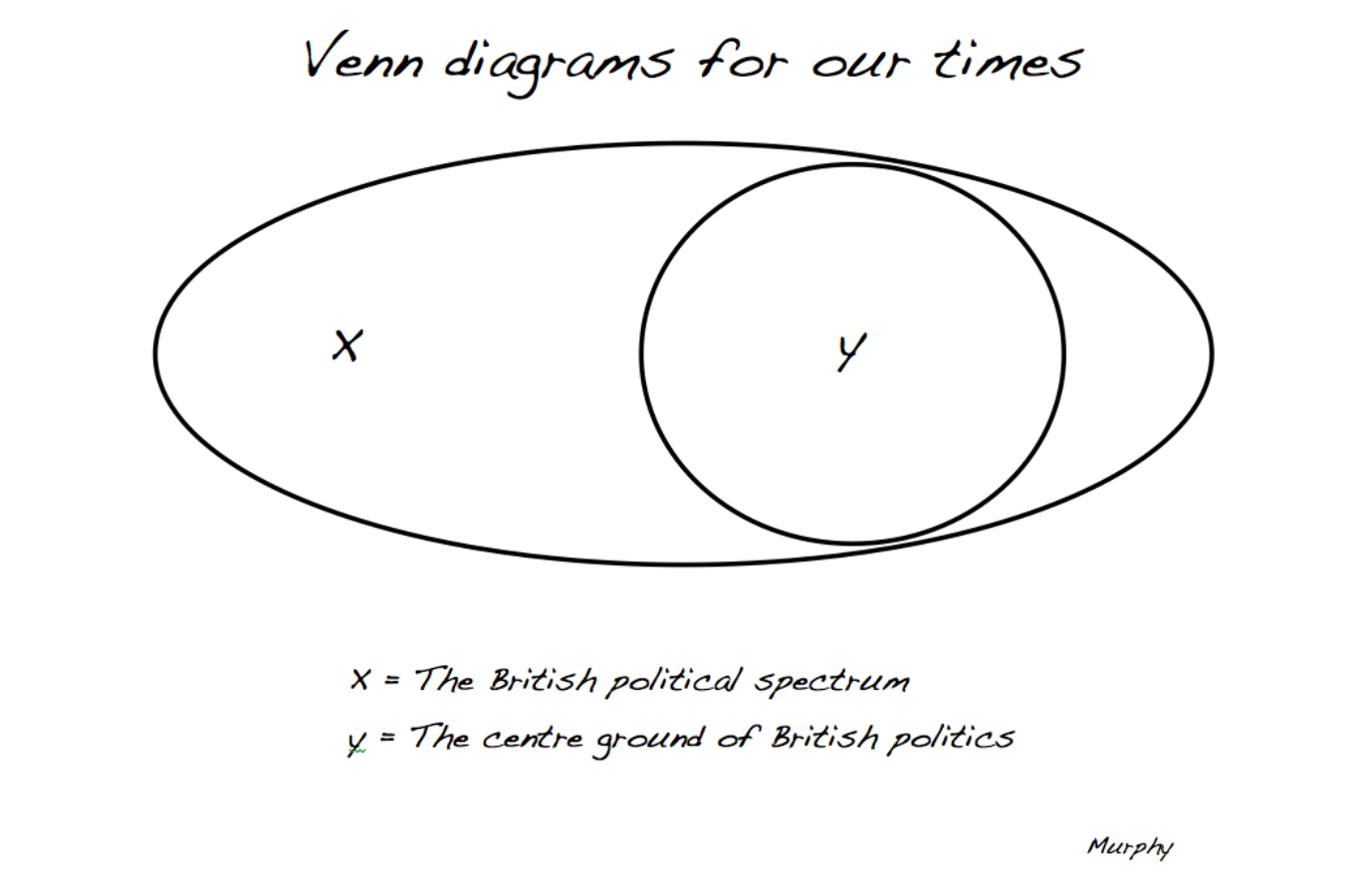
Was it Albert Einstein who said the definition of insanity was repeating the same thing over but expecting a different outcome? If so, I assume progressive centrists aren’t big fans of relativity.
I’m being facetious of course, but I was drawn to Einstein’s definition whilst pondering the rather galling spectacle of recent political discourse in which centrist politicians and commentators have claimed to represent some kind of neutral and reasonable position of compromise, trying to appear almost apolitical, in contrast to those to the left of them who they try to portray as the “Hard Left’, for calling for a different approach to address the multitude crises that are currently engulfing society and the environment. In so doing they seem blissfully ignorant of how extreme and radical their ‘centrist’ position would have been considered prior to the Thatcherite revolution, and how the locus of the centre ground of British politics took a sharp right turn following Thatcher’s time in office. A rightward shift which was then consolidated by New Labour’s self-annulment of its traditional social democratic values. Be under no doubt, when Thatcher claimed Tony Blair was ‘her greatest achievement’, she was confirming that New Labour had adopted the neoliberal argument underpinning Thatcherism; that markets are not only the most efficient way to deliver all goods and services, but for guiding almost all human action (example: carbon markets as a solution to climate change). New Labour’s adherence to the ideology was clearly evident when Blair made no attempt to reverse any Tory anti-union legislation, after all, a central element of neoliberalism is that unions are not considered legitimate democratic actors, but rather are dangerous monopolies which distort the market. And so, for a time, both left and right main political parties hailed the mantra; There Is No Alternative. It is this Thatcherite legacy upon which the current centre still sits. Yet those who claim this current centre ground and the moniker of ‘Moderates’ should perhaps reflect a little on the radical root of the ideology they appear to consider so reasonable, and reassess its success in delivering us from the political-economic crises of the late Seventies.
Neoliberalism was developed in response to the failure of classical liberalism after the Great Depression, and in reaction to the rise of Keynesian social democratic governments which came to power as a result. Neoliberals claimed all social democratic government inexorably leads to totalitarianism and therefore needed to be rejected for the sake of freedom itself. For the record, their ostensibly iron law arguments in this respect never actually happened. Anywhere. Ever.
Incubated by a small group known as the Mont Pelerin Society, neoliberalism was for both those on the centre right and left considered an extreme right-wing fringe ideology during the decades after WWII, until it started to find favour with Thatcher in the late Seventies, who on gaining power in 1979 embraced much of the philosophy. Why was it considered so extreme? Principally, because the philosophy is premised upon an inherent faith in the efficiency of markets over the democratic state. This was much the same philosophy which had led to the ravages of the Great Depression, and which arguably played a significant role in driving the world into the Second World War. The adaption, or ‘Neo’ the Mont Pelerin Society advocated to classical liberalism, was to enhance the power of the state to protect markets from the distorting effects of, well democracy, but in particular from the influence of the collective agency of the labour movement. Yet not only were the memories still strong in the immediate post war decades of the disastrous results the last time excessive faith was invested in liberal unregulated markets, but until the late Seventies, the Keynesian social democratic approach to government and political economy was recognised as delivering immense achievements; from the civilising institutions of the welfare state and NHS, social housing etc, to being responsible for the greatest levelling of inequality than at any other time in modern history, all whilst maintaining a uniquely stable period of banking.[1]These achievements were the direct result of the democratic influence on the economy, including a strong labour movement which was able to demand a more equitable share of the increasing profit margin the capitalist system produced.[2]It was this class compromise, otherwise known as the ‘post war consensus’ which delivered such a stable and productive era that it retrospectively became known as the Golden Age of Capitalism. Therefore to centrists and the left at the time, the ideology of neoliberalism, with its faith in unstable unregulated markets, and antagonistic and undemocratic belief that politics should not interfere in those markets, offered nothing less than tearing up the fundamental building blocks of the system which had delivered such a golden age. It is therefore no wonder that at that time centrists and the left, rightly considered it an extreme ideology.
For the sake of brevity, we will not explore here the fascinating and highly effective decades long strategy the Mont Pelerin society developed to depose the contemporaneous common sense of Keynesian social democracy with their extreme ideology, suffice to say it was successful, well at least it was successful in shifting the Overton window and reorienting the centre ground much further to the right. For if the acceptance of neoliberalism by the centre was merely a pragmatic acknowledgement that the increasing crises of capitalism demanded such a rightward shift, we should surely expect, forty years later to have arrived in the promised land of economic stability and political calm which its adoption promised to guide us, should we not? And if not, why then does the centre – the apparent zone of pragmatic reason – continue in its adherence to a political-economic model which not only so conspicuously delivers the vast majority of the benefits of capitalism to a tiny majority[3], but seems destined to push the whole system yet further towards the mother of all crises?
Since the onset of neoliberalism, three fundamental prerequisites of capitalism have displayed worrying trends that the model is uniquely unable to address. They are low economic growth, the erosion of sound money, and rising levels of inequality. What is more, these trends are mutually reinforcing. Let us first look at the increasingly low growth rates.
Low Growth
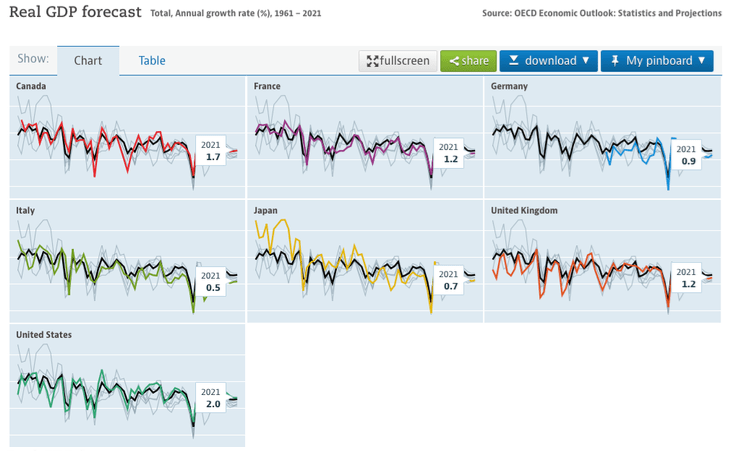
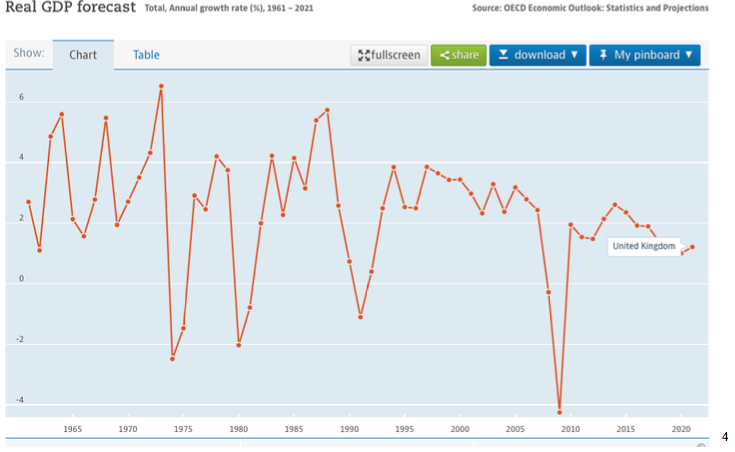
These OECD graphs clearly show the trend in persistent declining levels of economic growth in recent decades. Yet steady growth has generally accompanied capitalism throughout the ages. You will notice that the decline has been all the more exaggerated since the 2008 Financial Crisis. A financial crisis which many Keynesians predicted would be the outcome of neoliberal economics and its excessive faith in deregulated markets.[5]This graph fairly obviously shows us that neoliberalism has certainly not rectified this particular dynamic of the ongoing crises of capitalism, in fact it appears to be making it worse.
Whilst it’s true that low growth isn’t necessarily bad in the context of responding to climate change, if it’s a strategic policy, it should be accompanied by other proactive government measures to compensate for such a fundamental change in the model, for it is from economic growth that capitalism has generally delivered progress. In the absence of any counter measures, persistent low growth is indicative of an increasingly dysfunctional model. Moreover, low growth has significant implications for the second prerequisite; that of sound money.
Debt
Debt should be created on the condition that there will be sufficient economic growth, such that the lender will receive back not only the principle sum lent, but interest on top; interest gained through economic growth and an adequate assessment of the long term worthiness of the transaction. Yet since neoliberal deregulation there has been an explosion of debt derived from the creation of commercial bank money, which is much more reckless in its approach to the concept of sound money. As this newly created debt is quickly repackaged and sold on secondary markets, it is moved off the books of the banks who created the money, and therefore they have no incentive to behave responsibly in creating it in the first place. As such, the neoliberal banking system is ultimately undermining the very principle of sound money; a means of exchange in which people can have confidence in the currency and that the monetary system be stable and sustainable.
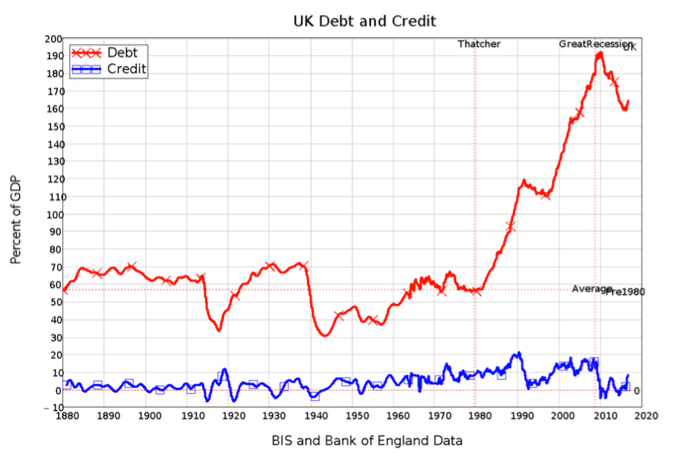
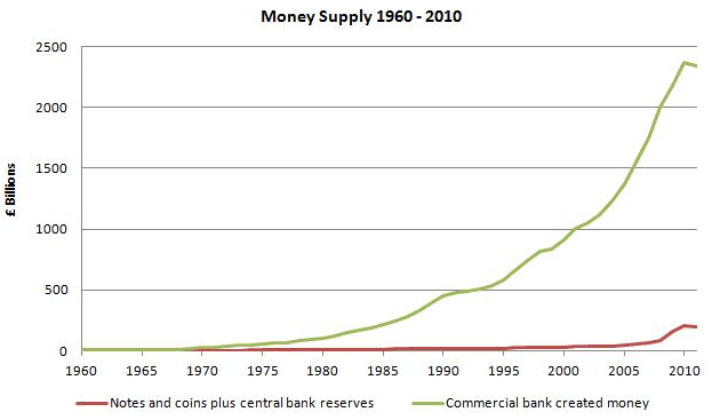
Does this look sustainable? The whole financial system is dependent on the maintenance of this debt, which as the 2008 crisis demonstrated is inherently unstable. It is not derived from healthy serviceable debt taken out for productive uses and which in time will work towards a general social progress, but rather is speculative, based on the assumption of ever inflating property prices. In effect it represents an inversion of the original raison d’etre of the finance sector, which historically had been to provide adequate assessment, and prudent funding for productive investment. Since the onset of neoliberalism, this type of benign activity has been increasingly crowded out by short term trading in speculative debt.
Of course, as we know from the bitter experience of the period of austerity, the debt is underwritten by the state and ultimately tax paying citizens and the services upon which they depend. With the help of the complacency of centrists who have capitulated to the financial sector, banks were able to privatize the profits and socialise the losses. This is not how capitalism is meant to work; in order to sustainably progress, capitalism should penalise those investors who have taken ill judged risks, otherwise a moral hazard is introduced into the system which incentivises reckless behaviour. If ever a clearer example was necessary of the extreme consequences of the excessive faith in markets, the 2008 Financial Crisis should have demonstrated it, along with banishing the neoliberal myth that the state is superfluous to the economy. Yet despite the glaring recklessness of the sector, the private losses of the banks were transferred on to the balance sheets of governments in the form of sovereign debt, which was is now being used as false evidence of some kind of profligacy of government spending which demands ever greater cuts to social expenditure.
The increase in debt is a combination of credit card and mortgage debt, the latter contributing to the ridiculous inflation in housing costs which has led to house prices doubling every 14 years.[8]That is an average yearly inflation rate of 6.9%, in comparison with average wage growth falling decade on decade, from 2.9% in the Eighties, 1.5% in the Nineties, 1.2% in the Noughties to zero growth in the Twenty-Tens.[9] It is this debt which has been fuelling the economy since the onset of neoliberalism. As wages have stagnated and social security expenditure cut, people have relied on the inflated value of their homes to fund their consumer spending. Whilst this giant Ponzi scheme benefits those in the finance sector, who profit from interest payments and transaction fees, homeowners are left with ever greater mortgage debt. In addition property inflation has resulted in locking out the majority of young people from home ownership, and increasingly from even renting. Surely if we are to consider a political-economic model to be working we would expect it to be able to deliver adequate housing for citizens in the fifth richest economy in the world? Yet neoliberalism’s reliance on the market to deliver housing has been an utter failure, therefore why are those that advocate for truly effective measures to resolve the crises considered radical leftists, whereas those in the centre are hailed as reasonable moderates, despite the absolute dearth of any significant solutions, beyond the almost contemptible idea of offering government loans for the young to rent? [10]
Increasing levels of inflation were one of the key criticisms that neoliberalism levelled at Keynesianism, yet not only was much of the Seventies inflation a consequence of rising oil prices, but as Ann Petittifor has highlighted, it was also more attributable to the early proponents of neoliberalism at the OECD pushing the UK economy to expand beyond its capacity at a time of full employment.[11] These dynamics were the root of Seventies inflation with unions merely seeking wage rises in line with inflation so as to avoid an effective pay cut, rather than the blame shifting portrayal perpetuated in the mainstream media of reckless unions chasing ever greater wages. From a class perspective it is also noteworthy that if wage increases match consumer price inflation, then this is much more a problem for the wealthy who hold the debt, as time itself erodes its value, whereas for those in debt, time effectively cancels out a portion of their debt, spurring economic activity as greater consumer spending is possible.
By the early Nineties consumer price inflation had reduced from the previous highs. But as noted above, not only was Keynesianism not its principle cause in the first place, the model was not without ideas as to how to tackle it.[12]However Thatcher’s victory, and her neoliberal response rejected any options other than antagonistically attacking the labour movement. As union power was constrained and full employment targets abandoned, unemployment levels topped 12%, and ultimately the institution of collective bargaining began its steady decline.[13]It was from this point that the post war gains in levelling wealth and income inequality went into reverse.
This brings us onto our third and arguably central prerequisite, that there is an adequate distribution of the gains made by the system.
Inequality
This graph highlights the steep rise in inequality since the onset of neoliberalism. You will notice that the negative trends did not change during the years of New Labour centrism.
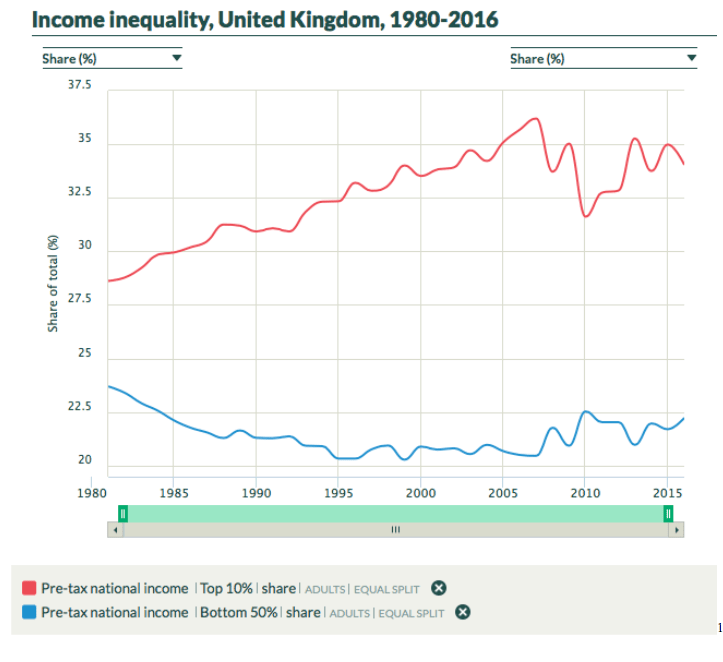
Increasing inequality not only undermines the legitimacy of capitalism as fewer people benefit from the system, it is also intrinsic to the negative trends of the two other prerequisites. If fewer people have less disposable income, so demand in the economy is subdued leading to lower growth, whilst in the opposite direction, lower growth can lead to more inequality as distributional conflict intensifies, and the need for increasing concessions to the poor generates demands from the rich that the poor must be subject to ‘market’, rather than ‘social’ justice. In addition, greater levels of inequality effect productivity growth, as low demand dulls competition, removing the exigency to improve productivity. Again, in a mutually reinforcing manner, this undermines wage growth, as if this is not to be a zero sum equation, wage growth must derive from productivity gains. Undoubtedly this rise in inequality is a result of declining wage growth consequent of the erosion of collective bargaining, combined with property inflation which has led to rising levels of debt as people are forced to borrow to compensate for their stagnating wages and exorbitant housing costs. These debt repayments then in turn take money out of the real economy, once again impacting on economic growth and inequality, and thus in a mutually reinforcing downward spiral, so neoliberal capitalism continues on a trajectory which can only be characterised as one of failure and immense risk for the majority of the nation.
Don’t mention class
The intrinsic importance of the role of inequality is quite obvious here, and whilst capitalism has gone through such periods in which inequality has become unsustainable and the system has displayed a generality of ‘morbid symptoms’ (to borrow a Gramscian phrase), these were eventually rectified through the collective agency of those most negatively affected; historically the working classes, who, through disruptive collective action, and mediated by the state, were able to force the owners of capital to accept a new class settlement, and reset the capitalist system, leading to a renewed period of stability.[15]Yet as a result of the attacks on the labour movement, the negative trend of reverse social mobility, and the more general dealignment of class identities, such a coherent class identity is missing. This lack of a collective identity highlights all the more, how effective neoliberalism has been in atomising the nation, and thereby neutering the collective agency necessary to challenge the model and force a reset as has happened during past periods of crises.
The recent general election highlighted this, when fresh in the wake of the worst performing decade for the vast majority of the electorate, the originators of neoliberalism were still able to hold onto power. Considering ostensibly progressive parties won the majority of votes, these were sufficiently split to allow the Tories to romp home as a result of the first past the post electoral system. This split was accentuated more than ever by the reorientation of the Labour party away from its adherence to neoliberal dictates, and further back to its original social democratic principles. This resulted in an unprecedented hostile reaction from those who claim the centre ground in both the Lib Dems and in Labour, declaring the leadership and their widely popular manifesto to be the ‘Hard Left’. Yet considering the above analysis which clearly shows the status quo to be increasingly dysfunctional, one must ask; from where do they draw their legitimacy? Their ‘centrist’ position which has been dominant for the last forty years has clearly not delivered a stable solution to the growing crises of capitalism. Whilst New Labour may have been able to ameliorate some of the worst excesses of neoliberalism, ultimately it still fundamentally embraced the philosophy, which is why they were not able to reverse the negative metrics identified in this article. Likewise, the Lib Dems time in coalition government did not offer us an example of the sunny uplands of their progressive centrism. In partnership with the Tories, (which says it all) they imposed the worst cuts to public services since their inception, all the while dishonestly claiming that the cuts were the result of a profligate Labour administration, rather than the 2008 Financial Crisis, a crisis which was just of likely to of occurred under their policy agenda as it was under New Labour or the Tories.
Why then are they so reactionary to the necessary policies needed in order to address the fundamental dysfunctionality of the current model, and on what logic can they even really claim the ‘centre’ ground. For even the most basic and intuitive understanding of a centre is that it is the middle area between two poles. The old social democratic centre ground of Keynesianism I think could rightly claim that moniker, as it brought together the hard right-wing anti-democratic tendencies of capital, with the hard left-wing anti-capitalist tendencies of labour. It then, through the state, was able to bring about a class compromise, a consensus between those competing ideologies. I see no compromise from the right-wing under neoliberalism, and only capitulation from those who claim the centre. They have not built a consensus between capital and labour, the rich and the poor, the right and the left. They have merely quaked in their boots at the power wielded by the neoliberal right, and surrendered any attempt to wrestle from the powerful, even a modicum of the social equity necessary if our society is to progress in a stable manner. They timidly refuse to address the underlying class nature of the negative dynamics we have identified in this analysis. Instead, like neoliberal cheerleaders they try to portray those that do as Marxists and extremists, wilfully joining in the illogical and irrational attacks on policies such as the nationalisation of some of our key natural monopolies, despite the overwhelming evidence from our European neighbours of the benefit of such policies. Myopically they colluded with the megaphone hysteria of the billionaire press that the policy agenda proposed in the Labour manifesto was akin to some kind of Stalinism, whereas if history is any judge, it actually offered capitalism the necessary room for adaption and renewal it so clearly needs.
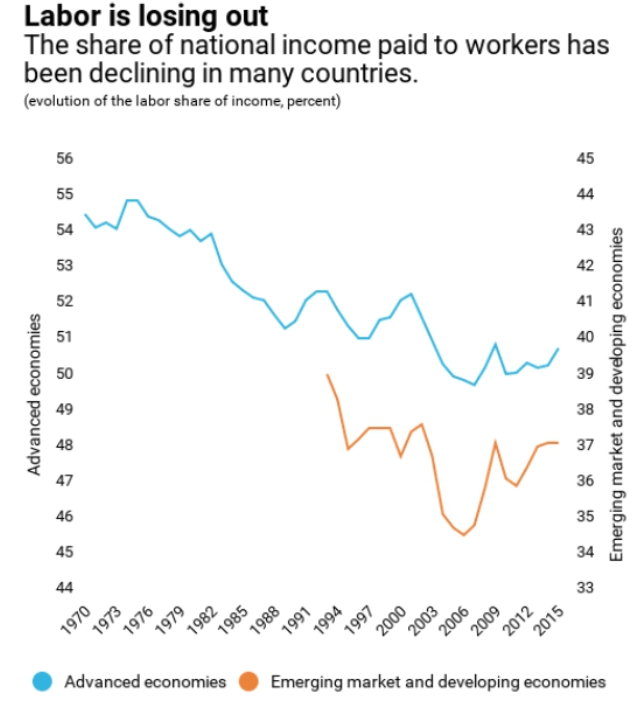
[16] Centrists’ eyes are wide shut to these (class) trends.
Ultimately, if the centrist shift to the right was justified by a pragmatic realism in the face of the increasing crises of capitalism at the end of the Seventies, where now is that pragmatic realism when confronted by the never ending crises of neoliberalism? Back then they were rightly suspicious that the root of the ideology was too extreme and would lead to instability and division, forty years later those earlier centrists have been proven right have they not? We do not after all live in stable and unified times do we?
Centrists seem to of mistaken the effectiveness of the neoliberal project at dominating the narrative; atomising the individual; neutering collective agency; and then quelling the dissent of those that are ironically fighting for compromise and stability by labelling them as radical extremists, for a stable political-economic model. Their misplaced, almost tribal loyalty to a vacuous centre is the enabler of the perpetuation of this zombie model. Whilst crises of capitalism continue unabated, centrists have been conditioned to react in horror at the mention that the rich keep getting richer and the poor keep getting poorer, i.e there is a very real (economic) class dynamic at play which is undermining the stability of the system. It is not class war to acknowledge and seek to rectify the negative dynamics that are at work in the economy and political sphere. Considering 99% of businesses in the country are small and medium sized, I find it hard to imagine they are all die-hard neoliberals who would not appreciate the acknowledgment of the increasing difficulties of doing business, and some proactive government input to address the problems.17 If these issues can be discussed in a reasonable and civil manner, rather than the hysterical talk of ‘Hard Left Radicalism’, I see no reason why business would not support a social democratic agenda. Productive business let us not forget, is no friend of the deregulated asset stripping financial sector, more often than not, it is its prey. Unfortunately though rather than address these issues head on like one should expect from leaders, they seem content to make excuses for the system, and dig an expensive hole in the ground which inflates by 6.9% per year, from which they feel somewhat (temporarily) insulated from the mounting crises engulfing society, and bury their head firmly in it, and from which we can just about hear the extent of their plans to address these crises: ‘keep calm and carry on……and tiptoe past the dragon’.
The solution is not capitulation.
Despite the abundant evidence, so called progressive centrists seem barely able to even imagine a slightly alternative economic model which could actually deliver on progressive values, let alone advocate for it. It seems such is their fear of encountering the wrath of the powerful who are gaming the system, and who have proved their ruthlessness in attacking those that don’t capitulate, that such a predictable reaction is the ground on which centrists justify their timid policy agenda. For example, New Labour’s deal with Murdoch that he would not attack Blair if his interests were left alone, or similarly, prawn cocktail offensives in which centrists must first promise the super-rich and powerful that they will be able to continue the very practices which are leading to the multitude crises which are destroying our society and environment.[18] It is not a ‘reasonable compromise’ to throw the poor under the bus in order to gain power. Centrists adherence to the neoliberal austerity logic and subsequent crises in public service is the most recent and conspicuous example of this.[19]
Whilst unfortunately the billionaire press are always going to give those who demand the super-rich pay their fair share of taxes a hard time, progressives should have the courage of their convictions and stand up to them, and make their very reasonable arguments to the British people. After all, isn’t the point of politics to offer people a plan which can improve their lives? Centrists seem to have surrendered the ideological battle ground, not on the strength of empirical evidence, but rather on the sophistication of their opponents’ capacity to dominate and frame the political-economic narrative that There Is No Alternative.
Aside from the many crises we’ve touched on in this article, the climate crises alone demands progressives must be firm in their commitments to real meaningful change, change that demands the powerful compromise as well. Straddling the fence on critical issues and gaining power, only at the cost of pre-emptively surrendering much of the power necessary to actually bring about progressive solutions is not a viable route to No.10. Let us not forget: ‘Power concedes nothing without demand’.[20]
For too long centrists have considered it a ‘reasonable’ position to just manage and maintain, or at best slightly ameliorate the status quo, despite all the indicators on the dashboard flashing red and the system in effect demanding ‘pull up, pull up’! We should be listening and taking heed of those indicators, and listening and taking heed of the vast majority of people’s demands for real change.
If the retort of progressive centrists to my argument is that I’ve been looking backwards and that society has moved on, my response would be on the contrary, in many ways the indicators are showing us the current system is the one in reverse, and its trajectory isn’t or ever was progressive or centrist. A neoliberal divided future which sacrifices the environment for short term gain is not an inevitability, the future is ours to reclaim, let us look back for inspiration, but move forward and invent anew.
References
[1]https://www.equalitytrust.org.uk/how-has-inequality-changed
[2]https://www.democraticaudit.com/2017/07/12/audit-2017-how-democratic-is-the-protection-of-workers-rights-within-the-uk/ (See chart 2)
[3]https://blogs.imf.org/2017/04/12/drivers-of-declining-labor-share-of-income/
https://www.equalitytrust.org.uk/scale-economic-inequality-uk
[4]https://data.oecd.org/gdp/real-gdp-forecast.htm
[5]https://www.intheblack.com/articles/2015/07/07/6-economists-who-predicted-the-global-financial-crisis-and-why-we-should-listen-to-them-from-now-on
[6]https://neweconomics.opendemocracy.net/the-ten-graphs-which-show-how-britain-became-a-wholly-owned-subsiduary-of-the-city-of-london-and-what-we-can-do-about-it/
[7]https://positivemoney.org/how-money-works/how-did-we-end-up-here/
[8]https://www.thisismoney.co.uk/money/mortgageshome/article-2921526/House-prices-risen-6-9-year-1980-according-ONS.html
[9]https://www.theguardian.com/business/2014/jan/31/real-wages-falling-longest-period-ons-record
[10]https://www.theguardian.com/society/2015/apr/10/help-to-rent-scheme-for-young-people-proposed-by-liberal-democrats
[11]Pettifor, A (2019) The Case for the New Green Deal. Verso. Pg 108.
[12]Campbell, J. L., (2001) Institutional Analysis and the Role of Ideas in Political Economy in (eds) Campbell J. L. & Pedersen, O. K.,The Rise of Neoliberalism and Institutional Analysis, Princeton University Press, Woodstock.
[13]https://tradingeconomics.com/united-kingdom/unemployment-rate
[14]https://wid.world/country/united-kingdom/
[15]Mason, P., (2015) PostCapitalism: A Guide to Our Future, Allen Lane, London. Pg 75
[16]https://blogs.imf.org/2017/04/12/drivers-of-declining-labor-share-of-income/
[17]https://www.google.com/url?sa=t&rct=j&q=&esrc=s&source=web&cd=12&ved=2ahUKEwi9hLH4pJznAhUBlFwKHXRnCQgQFjALegQIARAC&url=https%3A%2F%2Fresearchbriefings.files.parliament.uk%2Fdocuments%2FSN06152%2FSN06152.pdf&usg=AOvVaw0Z9h4H6kJ53K0vWkS_ZoJD
[18]https://www.theguardian.com/politics/blog/2010/feb/24/revealed-deal-between-murdoch-blair
[19]https://www.theguardian.com/commentisfree/2018/mar/14/austerity-poor-disability-george-osborne-tories
[20]https://www.brainyquote.com/quotes/frederick_douglass_134371
Venn diagram picture: http://www.taxresearch.org.uk/Blog/2013/09/20/venn-diagrams-for-our-times-the-centre-ground-of-british-politics/
 From the Outside Looking In
Looking forward to reading this and more. Thanks. Lucy
LikeLiked by 1 person
Cheers Lucy, hope you’re good. 🙂
LikeLike
Read. Very interesting and great to see some solid evidence and analysis of what is going on. It’s great to see the developments tracked over time and as a progression or regression! As ever you opened my eyes! Will share!
LikeLiked by 1 person
Thanks for the feedback Lucy. Yes I wonder how much analysis some of these people actually look at when taking a position. Anyway, (unfortunately) very interesting times we live in. I know it’s a bit of a long read, but sometimes it takes a while to be able to make the argument in full. My next blog will definitely be a little shorter.
Thanks for sharing as well. 🙂
LikeLike
Great overview of the last 40 years. As the decades mount up the evidence becomes starker. Although miserable, the clear direction of travel indicated in these graphs allows the debate to move on. neoliberals cannot keep touting it as a panecea to societal woes and maintain that their position is evidence based.
We need to make massive changes to the way we distribute resources/ organize ourselves, in order to survive (now is not the time for business as usual). TINA is losing its ideological grip. This blog is a timely demolition of a few persistent lies that are pushed about by vested interests.
LikeLiked by 1 person
Hi Abi, thanks for reading and commenting. Yes you’re right, they shouldn’t be able to keep on touting their free market myths in the face of this type of evidence. Problem is they’re very effective at controlling the narrative. Their response to these crises is so often, that far from their not being enough regulation, that there is too much and that’s the underlying cause of problems in markets. I only hope so called progressive centrists start to see the light and stop enabling them.
I’m pleased to see Keir Starmer and RLB, the front runners in the Labour leadership campaign say they’ll keep much of the policy agenda of the 2019 manifesto. They better stick to these promises once in office.
Absolutely Abi we need system change. Time is running out. What really concerns me though is how the 1 percent are gaming our democratic institutions with their immense resources, (Lobbying, media control, think tank networks etc). As we saw in the most recent election campaign, the Right feels no obligation to abide by what we might consider democratic norms. By appealing to people’s emotional reactions rather than their logic, they’re able to manipulate the public to vote against their own economic and political interests.
As you say though, we have to keep on making the case against the lies of TINA and hopefully, enough people will be able to see it for what it is; a one way route to disaster.
Anyway cheers again! 🙂
LikeLike